Free template
Free Purchase Order Template
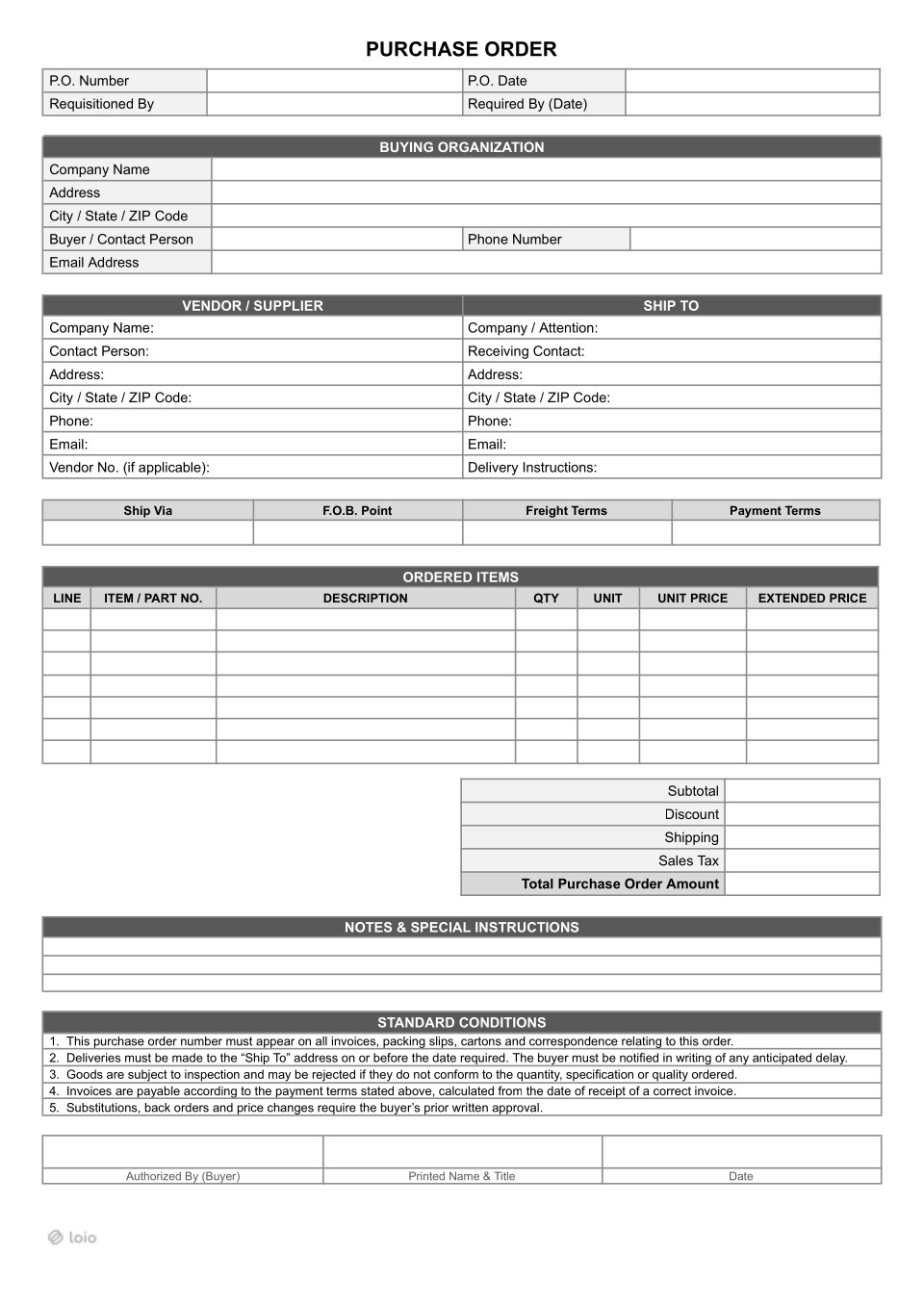
A purchase order (PO) puts the details of a planned purchase in writing before the goods arrive and the invoice is due. It records what your business is ordering, from which vendor, at what price, where the goods should go, and the delivery and payment terms.
Use this purchase order template when you already know what you need and have agreed on the main commercial details with the vendor. Fill in the order information, review the shipping and payment terms, and send the completed PO to the vendor so both sides have a clear record to work from.
Is a Purchase Order the Right Document for This Purchase?
Copy section linkA purchase order works best when your business is ordering goods from a known vendor and the main terms of the purchase are already clear.
For example, you may use a PO when you have selected a supplier for office equipment, building materials, parts, inventory, or other goods and need to record the approved quantity, price, delivery date, and shipping instructions. A unique PO number also gives the vendor, receiving team, and accounts payable a common reference for the order.
A different document may work better at another stage of the transaction. If you are still asking vendors for prices, you need a quote or request for quotation rather than a PO. An invoice is different too: the vendor issues it to request payment, while the buyer issues the purchase order to place the order.
For work that is mainly labor or services, consider a service agreement or statement of work instead. This PO form is primarily designed around goods: it contains fields for shipping, F.O.B. Point, ordered items, quantities, and freight terms. For an ongoing purchasing relationship, you may also use a Supplier Agreement to set the broader terms and issue individual POs for particular orders.
What Should You Decide Before Creating a Purchase Order?
Copy section linkYou can complete a PO much faster if you have the vendor's quote and the main commercial terms in front of you.
Before filling out the purchase order form, confirm the exact goods and specifications, quantity, unit price, delivery address, realistic delivery date, payment terms, and shipping arrangement. You should also know whether the vendor may substitute products or place items on back order, and who inside your organization has authority to approve the purchase.
Pay particular attention to F.O.B. Point and Freight Terms. They are not two names for the same thing. F.O.B. is a delivery term that can affect when responsibility for transit risk shifts, while freight terms address how transportation charges are handled. The two arrangements do not necessarily place cost and transit risk on the same party. U.S. federal procurement rules, for example, recognize “F.O.B. origin, freight prepaid,” where the seller pays the carrier upfront, while the buyer ultimately bears the transportation cost.
Have ready: the vendor quote, vendor details, delivery address, agreed prices, required delivery date, shipping terms, payment terms, and the name of the person authorized to approve the order.
What the Guided Interview Will Ask You
Copy section linkYou do not need to build a purchase order from scratch. Loio’s Guided Interview takes you through the information needed for the document step by step, using the same details that appear in the finished purchase order.
Be ready to provide:
- the P.O. number, order date, and required delivery date;
- the person requesting the purchase;
- the buyer’s company and contact information;
- the vendor’s name and contact details;
- the Ship To address and receiving contact;
- Ship Via, F.O.B. Point, Freight Terms, and Payment Terms;
- each item or part number, description, quantity, unit, and unit price;
- discounts, shipping charges, and applicable sales tax;
- any Notes & Special Instructions;
- the name and title of the person authorized to approve the purchase.
The most important questions are not necessarily the longest ones. Pay particular attention to the delivery date, F.O.B. Point, Freight Terms, Payment Terms, and any restrictions on substitutions or price changes, because these details affect what happens after the order is sent.
Once you have the vendor’s quote and these details ready, the interview helps you work through the purchase in a logical order and turn the information into a completed purchase order.
How to Fill Out a Purchase Order
Copy section linkWhether you complete the document through the Guided Interview or review the finished form yourself, check the following sections before sending the purchase order.
1. Identify the purchase
Start with the PO Number and PO Date. Use a unique PO number so the order can be referenced on correspondence, shipping paperwork, and invoices.
Next, enter Requisitioned By and Required By (Date).
“Requisitioned By” means the person inside the organization who requested the purchase. It is not necessarily the same person who has authority to approve it. The template separately asks for Authorized By (Buyer) at the end.
Choose the Required By date carefully. The template's Standard Conditions require delivery to the Ship To address on or before that date, so avoid entering an optimistic date that the vendor has not agreed it can meet.
2. Add the buyer, vendor, and delivery information
Complete the Buying Organization section with the buyer's company and contact details. Then add the corresponding information for the Vendor / Supplier.
Use the Ship To section for the actual delivery location. This may be the buyer's main office, but it could also be a warehouse, job site, branch, or client location. Include the receiving contact and any delivery instructions that the carrier or vendor will need.
3. Choose the shipping terms carefully
The PO template asks for Ship Via, F.O.B. Point, Freight Terms, and Payment Terms.
Under UCC § 2-319, F.O.B. is a delivery term. With F.O.B. place of shipment, the seller generally bears the expense and risk of getting the goods into the carrier's possession. With F.O.B. destination, the seller generally carries the goods at its expense and risk to the named destination and tenders them there. UCC risk-of-loss rules similarly distinguish shipment and destination contracts.
Freight Terms answer a different question: how are the carrier's charges handled? That means a vendor can, for example, prepay freight even where the agreed delivery arrangement shifts transit risk earlier.
For an international purchase, do not assume the U.S. domestic meaning of F.O.B. and Incoterms® FOB are interchangeable. Under Incoterms® 2020, FOB is specifically a sea or inland-waterway rule and transfers risk when the goods are on board the vessel. ICC advises considering FCA where goods are handed to a carrier before being loaded aboard, such as at a container terminal.
4. Describe exactly what you are ordering
For each line item, enter the item or part number, description, quantity, unit, unit price, and extended price.
Be specific enough that someone receiving the delivery can tell whether the vendor sent the correct goods. Depending on the purchase, that may mean including a manufacturer or model number, size, material, grade, color, or another specification rather than writing only a generic description such as “parts” or “supplies.”
The clearer this section is, the easier it is to identify a substitution, shortage, or invoicing error later.
5. Check the price and total
Use the totals section to record the Subtotal, Discount, Shipping, Sales Tax, and Total Purchase Order Amount.
The total shows the amount being approved for this order and gives accounts payable a figure to compare with the vendor's invoice. Make sure any discount or shipping amount matches the vendor's quote.
Enter sales tax only as applicable to the transaction. Sales and use tax rules, including resale and exemption certificates, are state-specific. The Multistate Tax Commission notes that even its multijurisdiction resale certificate is subject to individual state requirements and recommends checking with the relevant state revenue department.
6. Add order-specific instructions
Use Notes & Special Instructions for requirements that apply to this particular order.
For example, you might identify the vendor quote being accepted, specify a delivery window or packaging requirement, state that substitutions need approval, or add a project or job reference.
Do not try to squeeze a complicated commercial arrangement into a few lines of notes. If the purchase requires detailed warranty provisions, cancellation rights, acceptance testing, indemnities, liability allocation, or other negotiated protections, consider using a fuller Purchase Agreement or supplier agreement.
7. Review the standard conditions
The sample purchase order already contains five Standard Conditions. They require the PO number on invoices and packing slips, delivery by the Required By date, inspection of the goods, payment according to the stated payment terms, and prior written approval for substitutions, back orders, or price changes.
Condition 3 deserves particular attention. Buyers generally have a right under UCC rules to inspect delivered goods, but rejection must occur within a reasonable time after delivery or tender and the seller must be notified. A buyer that has had a reasonable opportunity to inspect and does not effectively reject the goods may be treated as having accepted them.
Inspect deliveries promptly and put any rejection or discrepancy in writing. Do not leave damaged, incorrect, or short shipments unresolved until the invoice becomes due.
8. Approve and send the purchase order
Finish the editable purchase order template with the buyer's authorization, printed name and title, and date.
This approval records who authorized the purchase on the buyer's side. It does not necessarily mean that the vendor has accepted the order. How acceptance occurs depends on the purchase order, any existing agreement between the parties, and what the vendor does next.
Who Should Sign a Purchase Order?
Copy section linkThis template includes an authorization line for the buyer, so it should be signed by a person who has authority to approve purchases for the buying organization. The person named under Requisitioned By does not have to be the signer unless they also have that approval authority.
The vendor does not necessarily have to sign the purchase order for a contract to arise. Depending on the wording of the order and the circumstances, a vendor may accept it by signing or acknowledging the PO, by a prompt promise to ship, or by shipment in circumstances covered by UCC § 2-206.
Still, a vendor’s written acknowledgment or signature can provide clearer evidence that both sides agreed to the same terms. This can be especially useful when the PO contains an important delivery date, shipping terms, payment terms, or special instructions.
If an existing supplier, master supply, or purchase agreement states how individual orders must be approved or accepted, follow that agreement. The buyer’s signature on this PO records the buyer’s authorization; it does not by itself prove that the vendor accepted the order.
When Does a Purchase Order Become Binding?
Copy section linkA standalone purchase order commonly functions as the buyer's offer to purchase goods on the terms stated in the PO. It does not always require a vendor signature to be accepted.
Under UCC § 2-206, an order to buy goods for prompt or current shipment may generally be accepted through a prompt promise to ship or by actually shipping the goods, unless the language or circumstances specify a different method of acceptance.
So, for example, you might send a PO on Monday and receive no signed copy back. If the vendor confirms that it will ship the order or begins performance in a manner that constitutes acceptance, a contract may still arise.
That is why it is good practice to request a clear acknowledgment instead of assuming silence means the vendor accepted every term.
An existing supplier or master agreement can change this process. It may state exactly when a PO becomes effective, how orders must be accepted, or which document controls if terms conflict.
Before the vendor accepts a standalone purchase order, the buyer may often be able to withdraw that PO, unless an existing agreement or other binding commitment limits that right. Once an order has been accepted, do not assume it can simply be cancelled without the vendor's agreement or another contractual or legal basis.
What If the Vendor Changes the Terms?
Copy section linkImagine that your PO orders 100 units at $20 each, delivery by November 1, with Net 30 payment. The vendor sends back an acknowledgment that adds a restocking fee, changes the delivery date, and includes different warranty or late-payment terms.
Do not assume that the terms on your PO automatically override everything on the vendor's form.
UCC § 2-207 addresses this common “battle of the forms” problem. A vendor's response can sometimes operate as an acceptance even though it includes additional or different terms. Between merchants, certain additional terms may become part of the agreement unless the offer limits acceptance to its own terms, the new terms materially alter the agreement, or the other party objects within a reasonable time.
The Loio purchase order form shown here does not contain language stating that acceptance is exclusively limited to the buyer's terms.
So when a vendor sends an order acknowledgment, read it. Compare the quantity, price, delivery date, shipping terms, payment terms, warranty language, restocking provisions, and any other added conditions with your PO. If you do not accept a change, object to it clearly in writing.
Neither side should assume that simply attaching its usual fine print settles the issue.
What Should You Do When the Order Arrives?
Copy section linkThe PO remains useful after the vendor ships the goods. It gives your receiving and accounts-payable teams something concrete to check against what actually arrived.
Inspect the delivery as soon as reasonably possible. Compare item numbers, descriptions, quantities, and specifications with the PO, and document damage, shortages, substitutions, or other discrepancies.
If the goods do not conform and you intend to reject them, notify the vendor promptly. UCC § 2-602 requires rejection within a reasonable time after delivery or tender and notice to the seller.
Then match the purchase order, delivery or packing slip, and vendor invoice. The PO tells you what was authorized, the receiving record shows what arrived, and the invoice shows what the vendor is asking you to pay.
If the invoice contains a different quantity, price, shipping charge, or other unexpected amount, resolve the difference before treating it as an approved change to the order.
For more on shipping paperwork, see Loio's guide to packing slips and bills of lading.
How Should You Handle Changes After the PO Is Accepted?
Copy section linkOrders change. A vendor may run out of one product, propose a substitute, request a later delivery date, or discover that a price has changed.
Record changes to the accepted order in writing. The template already states that substitutions, back orders, and price changes require the buyer's prior written approval.
Apply the same discipline to other important changes, such as quantities and delivery dates. Rather than approving a change only during a phone call, create a written record showing what changed and who approved it.
UCC § 2-209 provides that an agreement modifying a contract for the sale of goods does not need new consideration merely to be binding, although applicable writing requirements and the parties' own modification terms can still matter.
The practical rule is simpler: when the order changes, make sure the paperwork changes with it.
What Documents May Come Before or After a Purchase Order?
Copy section linkA purchase order is often one document in a longer purchasing process rather than the only agreement between the buyer and vendor.
For a larger or more complex one-time purchase, the parties may first sign a Purchase Agreement covering matters such as warranties, cancellation, acceptance, liability, and other negotiated terms. For an ongoing vendor relationship, the buyer and supplier may sign a Supplier Agreement or master supply agreement first and then issue individual POs for particular orders. In that case, the broader agreement may control how each PO is accepted and which terms take priority if documents conflict.
A vendor quote or order acknowledgment may also form part of the transaction record. Whether it needs a signature depends on the parties’ agreed process and the wording of the documents.
After the PO is accepted, later changes to price, quantity, substitutions, or delivery dates should be recorded in writing. For a material change, the parties may use an amendment or change order accepted by authorized representatives rather than relying only on a phone call or email thread.
When the goods ship and arrive, other documents serve different purposes. A packing slip identifies what is in the shipment, a Bill of Lading records transportation of the goods, and the vendor issues an invoice to request payment. These documents support the purchase process, but they do not replace the PO or any broader purchase or supplier agreement.
When Is a Purchase Order Not Enough?
Copy section linkA basic purchase order form template is well suited to straightforward purchases of goods. It becomes less suitable when the transaction needs extensive negotiated protections.
For example, consider a separate or additional agreement when goods are custom-made, the order has a high value, production requires a long lead time, cancellation would create significant costs, detailed warranties or acceptance testing matter, or the parties need substantial indemnity or liability terms.
For complex or recurring purchases, the PO may work together with a broader purchase or supplier agreement rather than standing on its own.
International transactions may also require additional attention to shipping, customs, insurance, governing law, and Incoterms® rules beyond what this domestic purchase order form is designed to cover.
And if the transaction is primarily for labor, consulting, staffing, or other services, start with an agreement designed for services rather than forcing the work into fields built around quantities, freight, and delivery of goods.
Why You Can Trust This Template
Copy section linkThis Purchase Order template is designed for use in the United States and is reviewed by qualified U.S. legal professionals. The supporting guidance is based on relevant U.S. laws, official legal sources, and government guidance, including UCC rules that apply to the sale of goods.
Because purchase terms, state law, and individual circumstances can vary, you may need to adjust the document for your transaction. For example, larger or custom orders may require additional terms on warranties, cancellation, acceptance, or liability.
Use Loio’s Edit PDF tool to revise or add terms before sending the purchase order, and check the laws and any existing supplier agreements that apply to your transaction.