Free template
Free Engagement Letter Template
A client hires a marketing consultant for monthly support. Three months later, the client requests extra campaigns, deadlines shift, and neither side remembers what the original fee covered.
This engagement letter template helps prevent those disagreements. It sets the rules for recurring services, payments, additional work, and ending the relationship, so month six doesn't depend on what was said in month one.
Create your agreement with Loio and collect both parties' signatures before work begins.
What Is an Engagement Letter?
Copy section linkA letter of engagement is a written agreement between a Client who orders services and a Provider who performs them. Here, the Provider can be an independent individual or business offering services, not a seller of goods.
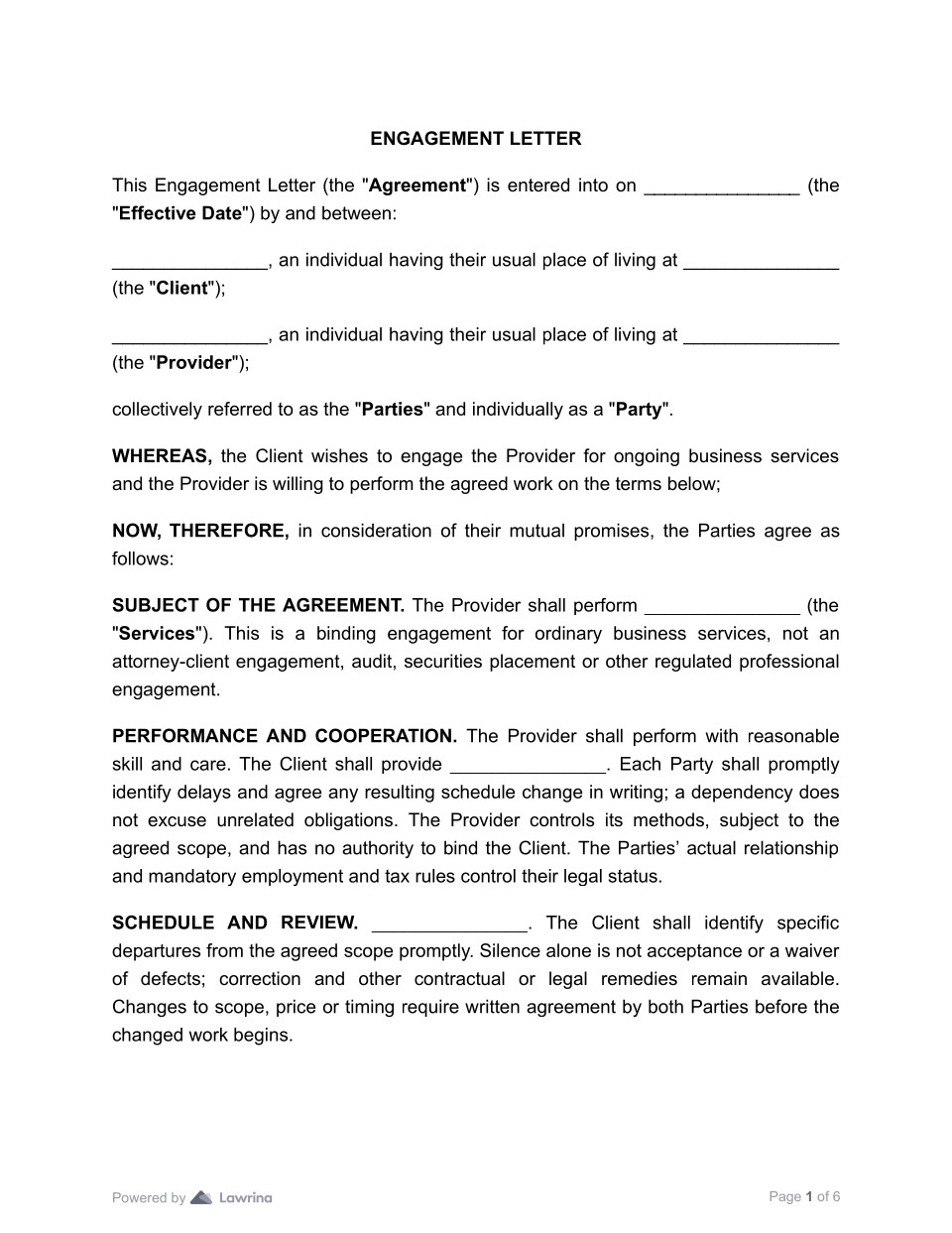
What does it include? This document identifies both parties and covers services, fees and invoicing, extra work, intellectual property, confidentiality, liability, termination, formal notices, governing law, and signatures.
Are engagement letters legally binding?
Yes, they can be. This engagement agreement template expressly establishes a binding relationship, not an informal welcome letter. Its terms can be enforceable when the agreement meets applicable contract-law requirements, including mutual assent, consideration, capacity, and lawful purpose.
Learn more about what makes a contract legally binding.
When should you use this template?
This engagement letter template is designed for ongoing business services without a predetermined completion date.
| Your situation | Best approach |
|---|---|
| Monthly bookkeeping, IT support, or marketing management | Good fit |
| Services involving personal data or licensed software | Fits with additions: consider a Data Processing Agreement or license terms |
| One project with defined deliverables | Service Contract |
| Several separately scoped projects | Master Services Agreement with individual Statements of Work |
| A worker directed and controlled like an employee | An appropriate employment arrangement |
This form isn't intended for attorney-client representation, audits, securities placements, or other regulated professional engagements.
For example, 22 NYCRR Part 1215 requires New York attorneys to address legal scope, fees, expenses, billing practices, and applicable fee-arbitration rights. Exceptions include certain matters with expected fees below $3,000. Audits have separate engagement requirements under AICPA AU-C Section 210, Terms of Engagement.
Solo lawyers and small firms can still use this document when hiring non-legal providers, such as IT consultants or marketing agencies.
What to Agree on Before Signing an Engagement Letter
Copy section linkThe biggest decisions concern what the Provider does, what the Client pays, and how the relationship changes over time.
1. Define the services and the Client's responsibilities
The Services field establishes which work is included in the engagement. Anything outside that scope requires separate approval.
Avoid vague wording such as "monthly marketing support."
Instead, describe measurable responsibilities:
Example: Manage two email campaigns per month, prepare one monthly performance report, and attend one 30-minute review call. Additional campaigns require separate approval.
Also specify what the Client must provide: account access, business records, materials, feedback, or approvals.
Use the Schedule and Review field to establish reporting dates or recurring meetings. The Client should identify specific problems promptly, although silence alone doesn't mean acceptance.
Under the Freelance Worker Protection Act (820 ILCS 193), qualifying individual freelancers earning at least $500 within 120 days must have written terms identifying services, compensation, service dates, and payment timing.
To address these requirements, itemize the work in Services, specify service dates, and set a clear payment-due mechanism. For example, if invoices go out promptly after month-end, the parties could choose payment within 15 calendar days after receipt. The law requires payment by the agreed due date; without one, payment generally becomes due within 30 days after completion of services.
The Provider controls its working methods, subject to the agreed scope. The Client shouldn't manage an independent Provider like an employee. The IRS evaluates actual behavioral and financial control, not simply the contract's label.
2. Choose a monthly fee or hourly rate
The engagement letter template offers two pricing models:
| Fixed monthly fee | Hourly rate |
|---|---|
| Best for predictable recurring work | Best for variable workloads |
| One agreed amount per calendar month | Pay only for hours performed |
| Partial months are prorated | Monthly invoices itemize time records |
| No unlimited services included | No guaranteed minimum hours |
The Provider sends invoices after each calendar month. The Client pays within the agreed number of calendar days after receiving an invoice.
Choose a payment method, including ACH, wire transfer, PayPal, Venmo, check, cash, or another agreed option. Verify new bank instructions through a trusted contact before transferring money.
No fee increase takes effect without both parties' written agreement. Consider scheduling a rate review every six or twelve months.
Also confirm whether your services are taxable. Since October 1, 2025, Washington's expanded sales-tax rules have covered certain advertising, IT, website development, and other services. The template requires chargeable transaction taxes to appear separately on invoices.
3. Decide how to approve extra work
A monthly fee doesn't cover every additional request.
Under Additional Work and Expenses, anything outside the agreed scope requires advance written approval of its scope and price or rate, signed by both parties.
Suppose a consultant manages two campaigns monthly, and the Client requests a third. Before starting, they should sign a short amendment stating what the additional campaign includes and what it costs.
A casual "go ahead" email isn't the signed approval this contract requires.
Expenses are included in the agreed fee unless the Client approves their nature and amount separately in writing beforehand. The Provider must keep supporting records and avoid duplicate charges.
If an invoice is disputed, the Client should identify the questionable items promptly and pay the undisputed balance on time. Both parties then review the supporting records in good faith.
4. Check ownership, confidentiality, and liability
Who owns the finished work? The Provider assigns rights in original deliverables created specifically for the Client, effective upon payment of the fees attributable to them.
The Provider retains pre-existing tools and materials. For Provider-owned background material incorporated into paid deliverables, the Client receives a perpetual license to use, copy, and adapt it as part of those deliverables.
Third-party materials remain subject to their licenses. The Provider must obtain approval before including materials that restrict the intended use.
If subcontractors contribute, the Provider needs the rights required for the promised transfer. Under 17 U.S.C. § 204(a), copyright assignments generally require a writing signed by the owner or authorized agent. A separate IP Assignment Agreement may help.
Confidentiality: The agreement protects information identified as confidential and information whose nature or disclosure circumstances reasonably establish confidentiality. Choose how long contractual obligations continue after termination.
If sensitive information must be exchanged before signing, consider a Mutual NDA. Personal-data processing may require a separate Data Processing Agreement.
The mutual indemnification provision is broad and includes losses and legal costs, subject to specified exclusions. It doesn't establish a general liability cap. Both parties should assess their exposure and check whether insurance covers contractual indemnity obligations.
5. Agree on termination and formal notices
The engagement continues until terminated. Either party may end it without cause by providing the agreed number of calendar days' written notice.
For a material breach, the other party receives the selected cure period after written notice specifying the problem.
Termination doesn't automatically accelerate future monthly fees. Partial final months are prorated where applicable, unearned advances must be refunded, and both parties must return each other's property, subject to lawful record retention.
Can you terminate by email? Not under this form's notice procedure. Formal notices must go to the stated address by personal delivery, tracked courier, or certified mail. They take effect upon documented receipt. The email and phone fields are contact details, not formal notice methods.
The agreement also asks for two states: one governing the contract and another identifying where courts will hear disputes.
Under Restatement (Second) of Conflict of Laws § 187, a chosen state's law is generally respected, subject to exceptions involving a lack of substantial relationship or other reasonable basis and certain overriding public policies. Choose a state meaningfully connected to the parties or transaction, and consider courts accessible to both sides.
An optional force majeure clause addresses extraordinary events beyond a party's reasonable control. Select how long such circumstances may continue before termination becomes available. Lack of funds alone isn't force majeure under this form.
How to Write an Engagement Letter
Copy section linkA letter of engagement template helps you avoid drafting every provision from scratch. Loio's Guided Interview follows the structure of the agreement.
Enter the Effective Date. Specify when the agreement takes effect.
Identify the Client and Provider. Enter legal names and addresses. For companies, include incorporation details and authorized representatives.
Describe the Services. State recurring tasks, the Client's responsibilities, and the service schedule.
Set payment terms. Select fixed or hourly pricing, enter the amount, choose a payment method, and specify when payments are due.
Choose termination periods. Specify the notice period and the time allowed to remedy a material breach.
Set confidentiality terms. Choose how long confidentiality obligations continue after termination.
Decide on force majeure. Include the optional clause and select the relevant termination threshold if needed.
Complete notice and legal details. Provide contact information, governing law, and the state where disputes will be heard.
Review and sign. Verify the provisions and complete both signature blocks.
Before finishing the engagement letter form, confirm that the scope matches your actual services and that all negotiated terms appear in the document.
Who Should Sign an Engagement Letter?
Copy section linkBoth the Client and the Provider should sign. The document includes separate signature blocks for each party.
Usually, the Provider prepares and sends the agreement, although either party can initiate it. If a company is involved, an authorized representative signs on its behalf and includes their name and title.
Signatures are especially important because this document contains an IP assignment and requires later amendments to be executed by both parties.
Electronic signatures are generally recognized under the federal ESIGN Act and applicable state laws, including enactments of the Uniform Electronic Transactions Act (UETA). Both parties should agree to transact electronically and preserve the signed record.
What Happens After Signing?
Copy section linkThe engagement creates an ongoing workflow, not a one-time paperwork task.
During the relationship:
Keep monthly invoices, time records, payment confirmations, and approved expenses.
Document extra services and rate changes through signed amendments.
Review the scope when workloads expand or new personnel join.
Revisit the terms if either party relocates to another state.
The Client should request an appropriate Form W-9 before the first payment when taxpayer information is needed for reporting.
For qualifying payments made in 2026, the IRS Form 1099-NEC threshold is $2,000, generally applying to reportable payments to noncorporate Providers, with exceptions. The threshold becomes eligible for inflation adjustments from 2027.
When the relationship ends, a Contract Termination Letter can document the decision, but it must be delivered according to the agreement's formal notice requirements.
Create and Sign Your Engagement Letter With Loio
Copy section linkThe hardest part of a recurring engagement is often keeping later changes consistent with the original agreement.
Loio helps you manage the process:
Create: Complete the Guided Interview to generate your document with the appropriate terms.
Review: Use Loio's PDF editor to revise wording and mark proposed changes as redlines or annotations before approval.
Sign: Request eSignatures from both parties. Signed documents are accessible in your Loio account, with a time-stamped audit trail recording signing activity.
Update: Prepare written amendments for additional work or revised fees and send them for signatures, retaining the executed changes alongside the original agreement.
If the Provider uses subcontractors, Loio's AI Contract Review can summarize their agreements and flag possible ownership or liability issues. Any promised IP assignment still needs to be verified.
Why You Should Trust This Template
Copy section linkThis engagement agreement template addresses practical risks in recurring business relationships: unclear services, unexpected charges, unpaid deliverables, ownership disputes, and difficult exits.
Its guidance reflects the actual agreement and relevant primary sources, including federal copyright law, IRS guidance, and state freelancer-payment requirements.
Its limits are explicit: This is a general US business-services form, not a profession-specific agreement or a guarantee of legal compliance.
Disclaimer: Contract requirements and enforceability vary by state, service type, and the parties' circumstances. Review applicable laws and consult a licensed attorney when necessary before signing.
Related Documents
Depending on your working arrangement, these documents may be useful:
Mutual NDA — before exchanging confidential information during negotiations.
Subcontractor Agreement — when the Provider delegates work to another professional.
IP Assignment Agreement — when separate documentation of transferred ownership rights is needed.
Statement of Work — when particular projects need detailed deliverables, timelines, and acceptance criteria.
Form W-9 — before payment when taxpayer information is needed for reporting.
Contract Termination Letter — when either party formally ends the arrangement.
For additional personal-data or software requirements, consider separate processing or licensing terms. Not every engagement requires these documents.
Also Read