Free template
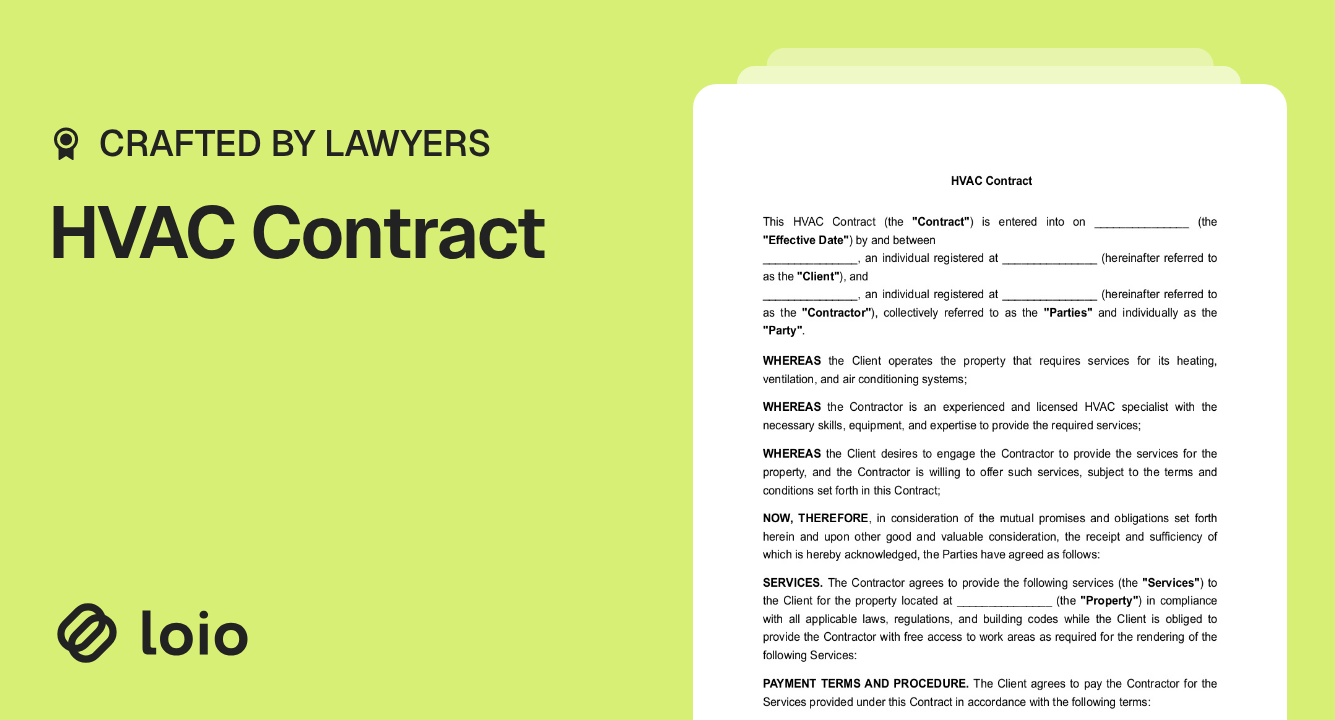
Free HVAC Contract Template

What Is an HVAC Service Contract?
Copy section linkAn HVAC contract template is a written agreement between a service provider and a client covering the installation, maintenance, or repair of heating, ventilation, and air conditioning systems. It sets out the scope of work, pricing, timelines, and warranty terms so both sides know exactly what's expected.
An HVAC service agreement is used by independent contractors, HVAC companies, and property owners hiring a technician for a residential or commercial job. Some contractors use a single HVAC maintenance agreement for recurring seasonal tune-ups, while others draft a new HVAC service contract for each one-time repair or installation.
Because HVAC work involves refrigerants, electrical systems, and equipment that can pose real safety and environmental risks if handled incorrectly, a written contract also gives both parties a clear reference for licensing, certification, and liability terms — not just price and scheduling.
When to Use an HVAC Contract?
Copy section linkAn HVAC contract template is useful in several common situations. HVAC contracts and HVAC service contracts generally apply whenever paid work is being performed on a heating, cooling, or ventilation system:
A property owner is hiring a technician for a new HVAC installation or system upgrade.
A business wants a recurring HVAC maintenance contract for seasonal inspections and tune-ups.
A contractor needs to document pricing, timelines, and responsibilities before starting repair work.
Either party wants clear warranty terms covering parts, labor, or both.
A landlord or property manager needs a standing service agreement across multiple rental units.
A homeowner wants written proof of licensing, insurance, and scope of work before allowing a contractor into their home.
When not to use an HVAC contract:
If the HVAC technician is being hired by a general contractor to complete part of a larger construction project, rather than being contracted directly by the property owner (use a subcontractor agreement instead).
If HVAC installation is only one part of a broader new-construction or renovation project with its own overall scope (use a construction contract instead).
If you're hiring the technician as a full-time or part-time employee rather than an independent contractor (an employment contract is recommended).
Who Are the Parties to an HVAC Contract?
Copy section linkHVAC contractor/technician: The individual or company performing the installation, maintenance, or repair work. Responsible for holding the required state license and any federal certifications, such as EPA Section 608, needed to handle refrigerants.
Client/property owner: The individual or business that hires the contractor and pays for the work. Responsible for providing access to the property and any information relevant to the job, such as existing system specifications.
Subcontractor (conditional): If the HVAC contractor brings in another licensed technician to complete part of the work, that person's role and licensing status should also be documented.
What Are the Key Components of an HVAC Contract?
Copy section linkWhether you're using an hvac service contract template for a single repair or an HVAC service agreement template for ongoing work, a complete agreement should include:
Names and contact info of both parties: Identifies who is bound by the agreement and how to reach them if questions come up during the job.
Description of the HVAC services to be provided: States exactly what work is being done — installation, repair, or maintenance — so there's no ambiguity about the scope once work begins.
Materials, equipment, and labor involved: This outlines which parts and equipment are used and whether labor is billed separately, which matters if a dispute arises over what was actually delivered.
Service dates or estimated timeline: Sets expectations for when work starts and finishes, or the schedule for recurring visits.
Payment terms and total cost: Document the price, payment structure, and schedule so both sides agree on the cost before work starts.
Warranty and maintenance conditions: Clarify what's covered under the manufacturer's warranty versus the contractor's labor warranty, which is one of the most common sources of disputes after a job is done.
Termination clauses and liability limits: define how either party can exit the agreement early and who's responsible if something goes wrong, protecting both sides from open-ended risk.
Signatures of both parties make the agreement enforceable — without signatures, there's no clear proof either side agreed to the terms.
What Are the Key Terms in an HVAC Contract?
Copy section linkSEER rating (Seasonal Energy Efficiency Ratio): A measure of an air conditioning system's cooling efficiency over a typical season. Higher SEER ratings mean better energy efficiency. Since January 1, 2023, new equipment has been tested and rated under the updated SEER2 standard, which uses stricter testing conditions than the original SEER metric — so a SEER2 number on new equipment isn't directly comparable to an older SEER rating without a conversion.
Manufacturer warranty: A warranty from the equipment manufacturer covering defects in parts, typically ranging from 5 to 10 years, separate from any warranty the contractor offers on their own labor.
Labor warranty: A warranty from the contractor covering their own artistry, typically shorter than the manufacturer's parts warranty, often 1 to 2 years.
EPA Section 608: A federal regulation under the Clean Air Act requiring technicians who work with refrigerants to hold an EPA certification. It applies nationwide regardless of state licensing rules.
Refrigerant handling: The process of adding, removing, recovering, or disposing of refrigerant from HVAC equipment, which is tightly regulated due to the environmental risks of refrigerant leaks.
Load calculation: An engineering calculation (commonly called a Manual J calculation) used to determine the correct size of HVAC equipment for a space, based on square footage, insulation, climate, and other factors. An undersized or oversized system driven by a skipped load calculation is a common source of performance complaints.
How to Fill Out an HVAC Contract Template?
Copy section linkTo fill out the HVAC service agreement template correctly, follow these steps:
- Enter the contractor and client details.
- Describe the scope of HVAC services (installation, repair, etc.).
- Add estimated service dates or duration.
- Include a breakdown of equipment, parts, and labor.
- Specify payment structure (flat rate, milestones, hourly).
- Add terms for warranties, liabilities, and cancellations.
- Review, sign (by hand or with eSign), and share copies with both parties.
A well-completed HVAC maintenance contract template ensures that your agreement is legally sound and professionally presented.
What Are the State Licensing Requirements for HVAC Contractors?
Copy section linkHVAC licensing requirements vary widely across the United States. Depending on the jurisdiction, HVAC work may require a dedicated state HVAC or mechanical contractor license, fall under another contractor classification, or be regulated primarily at the local level.
The National Association of State Contractors Licensing Agencies (NASCLA) offers a nationally recognized exam that satisfies the trade portion of the licensing requirement in several participating states, which can simplify the licensing process if you plan to work across state lines. Beyond the state license, any technician who handles refrigerants must hold an EPA Section 608 certification regardless of which state they work in — this federal requirement doesn't vary and doesn't expire once earned.
Before signing an HVAC contract, clients can verify a contractor's license directly with their state's licensing board. The ACCA State HVAC Licensing Map provides a state-by-state directory of licensing requirements and the agencies that issue them.
Do HVAC contractors need to be licensed in every state?
HVAC licensing requirements vary by state and locality. Some states require a state-level HVAC or mechanical contractor license, while others have limited or no statewide licensing requirements and may regulate HVAC work at the local level. Always check the applicable state and local licensing authority before performing or hiring HVAC work.
Is EPA certification required for all HVAC work?
EPA Section 608 certification is required for technicians who handle refrigerants—adding, removing, or recovering them from equipment. It's a federal requirement that applies in every state, separate from any state contractor license. Work that doesn't involve refrigerant, such as ductwork or thermostat installation, doesn't require this certification.
How long does an HVAC warranty typically last?
Manufacturer warranties on equipment parts commonly range from 5 to 10 years, depending on the brand and whether the unit was registered after installation. Labor warranties from the contractor are usually shorter, often 1 to 2 years, and cover the quality of the installation or repair work itself rather than the equipment.
Do I need a permit for HVAC work?
Many HVAC installations and major repairs require a local building permit, especially when electrical or gas line work is involved. Permit requirements are set at the city or county level, so they vary even within the same state. Your contractor should typically handle pulling the permit as part of the job, and this responsibility should be stated in the contract.
How often should HVAC systems be serviced?
Most manufacturers and technicians recommend maintenance at least once a year, and twice a year — once before cooling season and once before heating season — for systems that handle both. Regular maintenance affects both system lifespan and whether a manufacturer's warranty stays valid, since some warranties require documented annual service.
What is the 20-degree rule for HVAC?
It's a rule of thumb stating that a properly working air conditioning system should cool supply air by about 20°F compared to the air pulled in through the return vent. A smaller difference can indicate a refrigerant, airflow, or sizing problem, making it a quick way for a client to check whether a repair or installation was performed as expected.
What are the 3 R's of HVAC?
Recover, recycle, and reclaim — the three practices technicians follow when handling refrigerant under EPA Section 608 rules. These practices prevent refrigerant from being released into the atmosphere during service, repair, or disposal of HVAC equipment.
What happens if the contractor isn't properly licensed?
Hiring an unlicensed contractor for work that legally requires a license can create real risk: the work may not pass inspection, insurance claims related to the job may be denied, and in some states, the contract itself may be difficult to enforce. Verifying a license before signing protects both the client and the agreement's legitimacy.
Requirements for this document vary by state. Review your state's laws and procedures — or consult a licensed attorney — before using this template to ensure it's valid and enforceable where you live.
Sources
Related documents
Also read