Free template
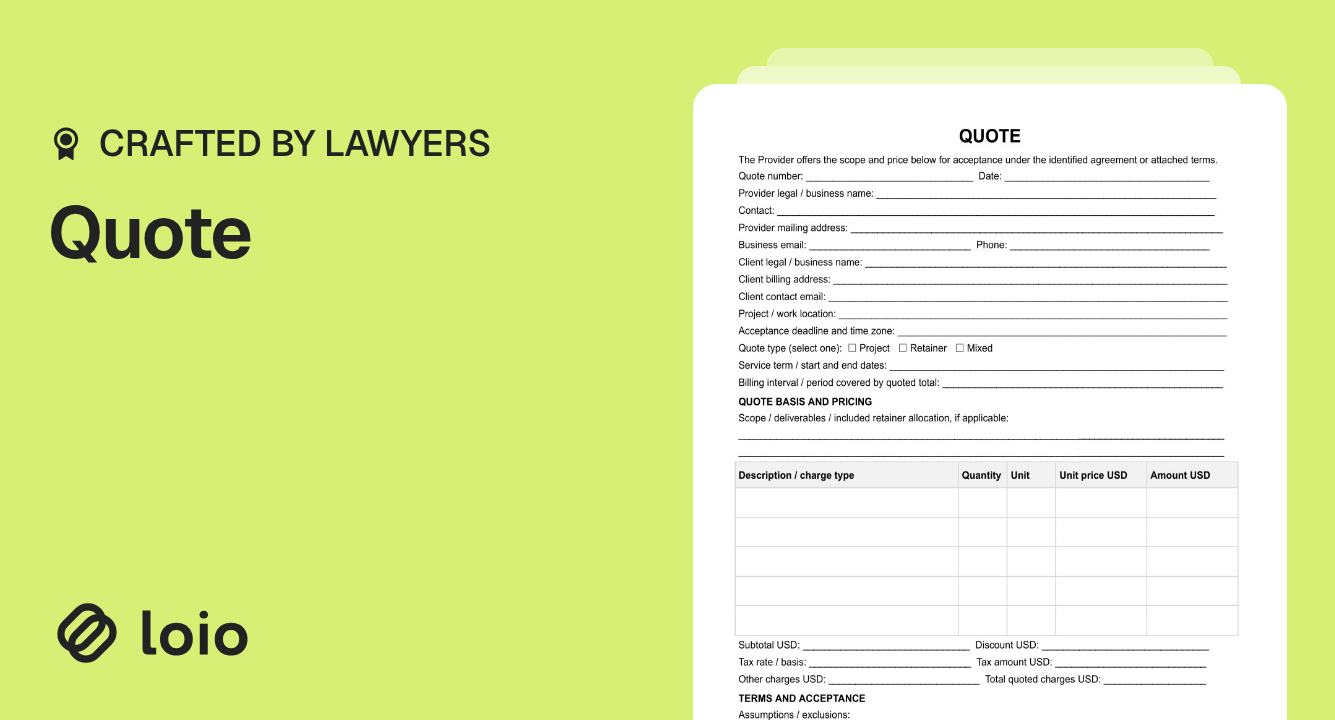
Free Quote Template
A client asks, “How much will this cost?” You know your rates, but a number alone doesn't explain what's included, how long the price applies, or what happens if the client requests more work.
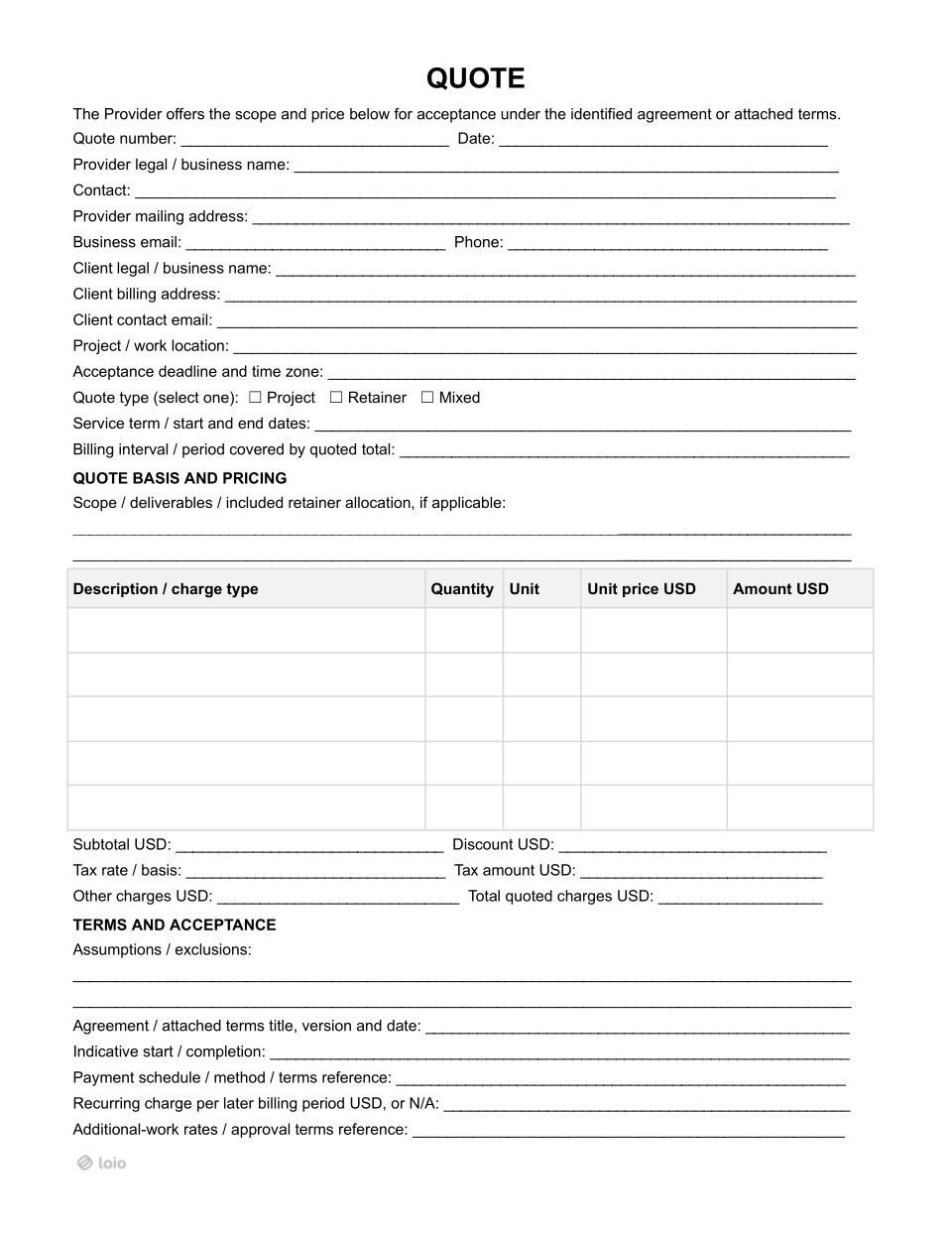
Use this free quote template to offer defined services at an itemized price, identify the applicable terms, and set an acceptance deadline. Your client can sign to approve the scope and charges for the stated period.
What Is a Quote Template, and When Should You Use One?
Copy section linkA quote template helps a service provider offer defined work at a stated price. This business quote template isn't just a pricing worksheet: it offers the work for acceptance and includes a client signature block.
| Document | When to use it |
|---|---|
| Quote | The work is defined, and the client needs a price to accept. |
| Estimate | The final cost may change because quantities or scope remain uncertain. |
| Proposal | You're pitching an approach or negotiating options. |
| Invoice | You're requesting payment under an agreed billing arrangement. |
For recurring supplies of goods, use suitable terms and conditions of sale, potentially documented in a Sales Contract, instead of relying on this service quote alone. For work already performed, issue an invoice when payment is due.
What should a quote include? Identify the Provider and Client, deliverables, itemized charges, discounts, applicable tax, total, billing period, acceptance deadline, referenced terms, and authorized signer.
Before you start, prepare:
The agreement or terms supporting your quote;
The client's legal name and authorized signer;
The scope expressed as deliverables;
The pricing units, billing period, and payment setup.
Is the quote the final price? The accepted price generally covers the defined work and period, not unapproved additions or future periods.
Certain transactions made at a consumer's home or a temporary location may be covered by the FTC Cooling-Off Rule (16 CFR Part 429). Check thresholds and exemptions, including certain emergency repairs; covered sales require cancellation notices and forms absent from this PDF.
Is a Signed Quote Legally Binding?
Copy section linkYes, a signed quote can create a binding contract if it is a valid offer, properly accepted, and meets applicable contract requirements. This quotation template expressly offers the scope and price for acceptance; signing confirms the client's agreement to the stated charges and identified terms.
How long is a quote valid?
Enter an Acceptance deadline and time zone, such as "November 20, 2026, 5:00 PM EST." The time zone matters when parties operate in different states or the client signs near midnight on the last day.
Choose a deadline that reflects how long you can hold your rates, resources, and availability.
Under Restatement (Second) of Contracts § 41, the client's power to accept generally ends at the time specified in the offer. A late signature normally cannot accept the expired offer; it may instead constitute a new offer for the Provider to accept or reject. The deadline also doesn't necessarily make the original offer irrevocable before expiration.
Which terms become part of the agreement?
Use Agreement / attached terms title, version, and date to identify exactly which terms apply. Reference an existing Service Contract, or attach terms for a new client before requesting a signature.
In Shaw v. Regents of the University of California, the court explained that incorporation by reference requires a clear, unequivocal reference; attention drawn to that reference and consent; and terms that are known or readily available. “Our standard terms apply” without an identifiable version risks a dispute. Check that payment and additional-work references agree with the attached agreement.
Who should sign the quote?
The Client's authorized representative signs this PDF, using the name, title, signature, and date fields. The Provider issues the offer; there is no separate Provider signature block. An existing agreement may call for further approvals or both parties' signatures.
Confirm that the signer can authorize spending; a project contact may not have that authority. Acceptance can sometimes occur without signing, but this form is specifically designed to document express signed approval.
How to Quote Projects, Retainers, and Mixed Services
Copy section linkTotal quoted charges USD field applies only to the stated billing period. Select Project for defined work, Retainer for ongoing services, or Mixed for one-time and recurring charges together. A freelancer can use this as a job quote template for a website redesign; an agency may use Mixed for setup plus monthly maintenance.
| Charge | Amount |
|---|---|
| Website setup — one-time, per project | $1,500 |
| Maintenance — recurring, monthly (first month) | $400 |
| First-period total | $1,900 |
| Maintenance — recurring, monthly (each later month) | $400 |
Illustrative amounts before tax and any other charges.
For this example, enter $1,900 under Total quoted charges USD, specify the first month under Billing interval/period covered by quoted total, and put $400 in Recurring charge per later billing period USD, or N/A. State the service start and end dates.
If the first month is discounted, say whether that discount carries forward; match the later recurring charge and service term to the renewal clause. For retainers, explain whether the fee buys prepaid hours, reserved availability, or another allocation, and what happens to unused hours.
Advance legal fees may require trust-account treatment under ABA Model Rule 1.15(c) and applicable state rules. A separate Fee Agreement may be necessary.
How to Fill Out This Quote Template
Copy section linkTo make a quotation for prices, start with the deliverables, set the billing units, calculate each line, and identify the terms the client will accept. This template for quotation already includes the fields you need.
1. Identify the parties
Enter the Quote number and date, Provider's legal name and contact information, Client's legal name and billing details, and the project location where relevant. Use a unique number that can appear on later orders and invoices.
2. Define what you're delivering
Under Scope/deliverables / included retainer allocation, describe measurable work: “Five-page website redesign, mobile optimization, and two revision rounds,” rather than “Website services.” For complex milestones or acceptance criteria, attach a Statement of Work.
3. Calculate the price
Fill in Description/charge type, Quantity, Unit, Unit price USD, and Amount USD. Label each line as project, one-time, or recurring and specify its billing unit (such as hours, deliverables, or months). Calculate Subtotal, Discount, Tax, Other charges, and Total without counting a charge twice.
Under Restatement (Second) of Contracts § 153, reproduced by the Florida Bar, relief for a one-sided mistake requires a mistake about a basic assumption with a material adverse effect, no allocation of that risk to the mistaken party, and either unconscionable enforcement or the other party's knowledge, reason to know, or responsibility for the mistake. Recheck units and arithmetic.
4. Specify exclusions and extra work
Use Assumptions/exclusions to define what's outside the price:
“Client provides approved copy and website access; stock images and revisions beyond two rounds are excluded.”
Under Additional-work rates/approval terms reference, identify the rate and process for approving extras.
5. Link payment and timing terms
Complete Payment schedule/method/terms reference and Indicative start/completion. The PDF refers to payment arrangements rather than providing a full payment clause; binding delivery dates may likewise belong in the identified agreement.
6. Review and send
Check names, quantities, tax, billing period, acceptance deadline, and the referenced terms. Provide those terms before signing. If someone requests a quote letter template, send this itemized form with a short email naming the work, total, and deadline rather than drafting another agreement.
How Should You Handle Sales Tax and Other Charges?
Copy section linkService taxability depends on the state and the work involved. Under Texas Tax Code § 151.351, for example, 20% of qualifying data processing charges are exempt, so 80% is generally taxable. Use Tax rate/basis to explain what you're taxing. Identify taxable and non-taxable work separately where appropriate, although separate lines don't automatically establish an exemption. Obtain and verify a client's exemption certificate before invoicing.
Count each extra charge once. For $120 in travel costs, either put "Travel — $120" in the pricing table and write N/A under Other charges USD, or leave it out of Subtotal and enter $120 in Other charges USD, identifying the fee in the assumptions or notes. Don't use both. If the travel charge is taxable, itemizing it in the table makes it easier to include in the tax basis.
What Happens After the Client Signs the Quote?
Copy section linkThe signed quote is not an invoice. Verify that an authorized person accepted the right version on time and received the applicable terms. Bill only when the agreed payment trigger occurs, such as acceptance, a milestone, or the next billing period.
If the client's procurement team issues a Purchase Order, ask it to reference the Quote number and check for conflicting terms. If the scope changes, obtain an approved change request using the agreed additional-work rates before performing extra work.
Send, negotiate, and reuse quotes in Loio
Email threads and scanned signatures can leave several quote versions circulating. In Loio, edit the document and request the client's eSignature; the client can sign on desktop or mobile.
For negotiation, invite the client to collaborate on the same draft. Their suggested changes can be reviewed as redlines before the final version is sent for signing. Loio's audit trail records signing timestamps, helping you compare the signature with the Acceptance deadline and time zone.
Loio signature requests remain valid for 30 days, but this technical expiration is separate from the offer's acceptance deadline. For recurring retainers, use a prior request again: the new copy retains prepared fields without the prior signer's entries, so you can update the period and charges rather than rebuild the form. Add the appropriate recipients and signing order for the new period.
Why You Should Trust This Template
Copy section linkThis Quote Template helps prevent common disputes over scope, unexpected charges, and unclear acceptance terms. Its fields distinguish one-time and recurring fees, define exclusions, and document the client's approval.
Our guidance follows the actual two-page form and draws on U.S. contract law, state tax rules, and official regulatory sources. We also explain when additional agreements or state-specific disclosures may be needed.
Disclaimer: This template and description provide general information, not legal or tax advice. Requirements vary by state, service, and transaction; review the applicable rules and terms before use.
Related Documents
Also Read