Free template
Free Retainer Agreement Template
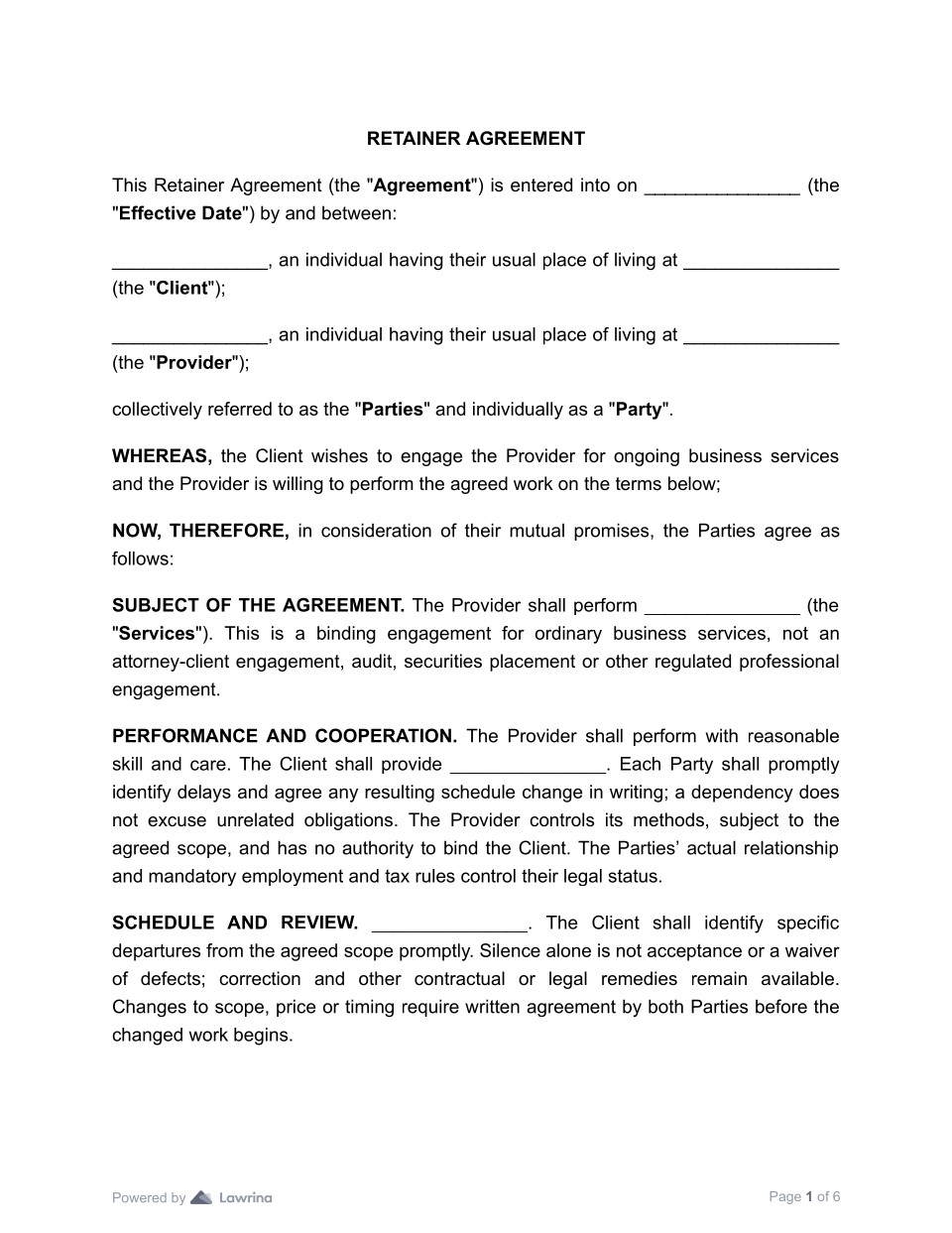
When occasional jobs turn into monthly work, both sides need clear limits. This free retainer agreement template sets a fixed fee for defined hours or results, without renegotiating every small request.
It also covers extra work, payment, ownership, and termination.
What Is a Retainer Agreement?
Copy section linkA retainer agreement sets terms for recurring services or reserved availability. Yet retainer can mean three things:
| Model | What the fee pays for |
|---|---|
| Availability | The Provider's availability, rather than particular tasks. |
| Advance deposit | Money paid upfront and applied to fees as work is earned. |
| Fixed monthly allocation | A defined number of hours or specified results each month. |
This template uses the third model. The Provider invoices after each month; the fee is not automatically an advance or nonrefundable deposit. If the Parties agree on an advance, the Provider must refund the unearned balance at termination.
What should a retainer agreement include? Check that these essentials are clear:
Client and Provider identities and authorized signers;
Services, Client responsibilities, and schedule;
Included hours or monthly deliverables;
Fixed fee, invoicing, payment deadline, and method;
Confidentiality, intellectual property, and extra-work approvals;
Termination notice, governing law, and signatures.
When to Use This Retainer Contract Template
Copy section linkUse this form for steady monthly bookkeeping, IT support, design, content production, or consulting. A retainer template works best when both Parties can estimate the allocation and review what was delivered each month.
For a one-time project with a finish date, a Service Contract or Statement of Work may fit better. Pure hourly work without a fixed monthly fee may call for an Independent Contractor Agreement.
This is not an attorney-client engagement agreement. A firm may use it to retain an outside bookkeeper or IT specialist, but not to set fees for its legal clients. Under the ABA Model Rules discussed in Formal Opinion 505, advance legal fees generally remain client money until earned; calling them “nonrefundable” does not change that. Check the applicable state's ethics rules.
If the Provider handles customer or employee personal data, consider a separate data-processing and security addendum before processing starts.
How Does the Monthly Retainer Work?
Copy section linkHours or deliverables: choose one measure
The MONTHLY ALLOCATION section offers two alternatives. Choose Hours for variable requests, such as troubleshooting: enter the included hours, and the Provider keeps time records and reports usage monthly. Choose Results for repeatable output, such as four articles or a monthly financial close. Describe the results precisely.
Match the allocation to the Services and Service Schedule. Decide who submits requests, reviews work, and records delays awaiting Client input.
Unused allocation isn't failed performance
Suppose an IT specialist charges $1,200 for 20 hours monthly. In a quiet month, the Client requests 12 hours. The unused eight don't roll over or become an automatic cash credit under this form.
If the Provider instead fails to perform requested or agreed work, the unused-allocation rule doesn't remove the Client's remedies, refunds, or credits for breach. Keep records showing which situation occurred.
Extra work needs approval
In a busy month, the Client requests 26 hours. The extra six are not automatically authorized or billable. Both Parties must first sign an approval specifying their scope and price or rate. Expenses outside the fee also need advance approval.
What to Check Before Signing a Retainer Contract
Copy section linkMonthly invoices and safe payment details
Monthly invoices identify the service period and itemize approved extra work and expenses. Payment is due within the agreed number of calendar days after receipt. With Net 30, March work invoiced in early April may not be paid until early May — something a Provider should budget for.
Choose one payment method: cash, check, ACH, wire, PayPal, Venmo, or another agreed method. ACH and wire clauses specify the Provider's bank and routing details. Transaction taxes, where lawfully chargeable, must be stated separately. If the Client disputes an invoice item, it should identify that charge and pay the undisputed amount on time.
A fake “we've changed banks” email can redirect a recurring payment. Follow Nacha's Business Email Compromise Action Plan: confirm changed instructions using a channel other than the one requesting the change. Call the notice-contact phone number in the signed agreement, not a new number from the email. Under NOTICES, a phone call verifies details but is not itself formal contractual notice.
A long-running freelancer may raise classification questions
“Our freelancer has worked only for us for two years — is that a problem?” Not automatically, but long, exclusive, fixed-fee work is exactly the pattern classification rules scrutinize. The IRS looks at actual control and independence, not just the contract's label.
California is a useful warning. Under the ABC test, a covered worker is presumed to be an employee unless the hiring business demonstrates all three conditions. The business-to-business exception (§2776) and professional-services exception (§2778) each have specific conditions; check every requirement for the services involved, including writing, design, or marketing. A qualifying exception may trigger a different classification test.
Before continuing a long retainer with an individual:
Ask whether the Provider serves other clients and offers services publicly.
Check their business license, if required, and whether they use their own tools.
Have the Client's manager direct results, not daily hours or methods.
Ask an accountant or employment lawyer to review the actual relationship.
If the Client sets the person's schedule and supervises them like staff, an employment arrangement or staffing agency may be more appropriate.
Ownership transfers when work is paid for
Under INTELLECTUAL PROPERTY, original deliverables created for the Client are assigned when the fees attributable to them are paid. For an ongoing arrangement, that generally means ownership transfers month by month as invoices are paid; final-month work transfers after the applicable prorated fee is paid.
Both Parties retain pre-existing materials. The Client receives a perpetual license to Provider-owned background material in paid deliverables; third-party licenses still apply. Copyright transfer generally requires a signed writing under 17 U.S.C. §204(a).
This form uses assignment, not a blanket work made for hire clause. In California, a qualifying signed work-made-for-hire provision can treat the commissioned creator as an employee for workers' compensation (§3351.5(c)) and the commissioning party as an employer for unemployment insurance (§686). This links back to contractor classification.
Confidentiality must outlast access
The clause protects information marked confidential and information whose nature reasonably calls for protection, including credentials and nonpublic customer records. The Parties can choose whether obligations continue after termination and for how long.
Consider a consultant who had access to logins and customer data for three years: leaving the project doesn't erase what they learned. Choose a realistic survival period, revoke access at handover, and remember mandatory legal protections may last longer.
The form's mutual indemnification clause is broad and has no overall liability cap; consider whether that fits the monthly fee.
Termination and partial months
Can you back out? Either Party may terminate without cause by providing the number of calendar days' written notice entered in the form. Material breach has a separate written-notice and cure period. Ending the arrangement doesn't accelerate all future monthly fees.
For a partial first or last month, both fee and allocation are prorated by calendar days. An indivisible deliverable needs a written partial-month delivery plan; proration alone doesn't mean unfinished work was accepted. Arrange the return of property, Client accounts, and access credentials.
Changes to scope, rates, or allocation require a written amendment signed by both Parties. Optional force majeure language, if selected, doesn't excuse lack of funds alone.
How to Fill Out a Retainer Agreement Form
Copy section linkUse the interview to complete the document in seven steps:
Identify both Parties. Enter the Effective Date, legal names, and addresses. For a business, add its incorporation law and the name and title of the representative authorized to act for it.
Describe the Services. Specify ongoing tasks, what the Client must provide, and the service schedule. Include clear review or acceptance criteria for results.
Choose the monthly allocation. Enter included hours or list deliverables. Check that the Services and allocation describe the same work.
Set the fixed fee. Choose the payment deadline and method, then double-check account details where relevant.
Set exit and confidentiality rules. Enter termination notice days, the material-breach cure period, and any post-termination confidentiality period.
Review optional and legal terms. Select force majeure if wanted, specify its duration threshold, and enter both notice contacts, governing state law, and court forum.
Review the signature blocks. Check that the final document identifies the correct Party and signer on each side.
Who signs? The Client and the Provider should both sign this form, as its two signature blocks contemplate. An individual signs personally; an LLC or corporation acts through an authorized representative. An employee who merely submits requests doesn't necessarily have authority to sign or approve extra work. See who can sign for a company.
The Effective Date can precede or follow the last signature; agree on it deliberately.
Sign and Update the Agreement in Loio
Copy section linkThe AMENDMENTS clause requires changes to be documented in writing and signed by both Parties. A casual email exchange isn't a substitute for that required signed amendment.
In Loio, fill out the agreement, invite the other Party to review the same draft, and discuss proposed edits. Suggestions appear as highlighted additions, deletions, or replacements; the document owner or authorized editor can accept or reject them before signing. You can also edit and redline a PDF.
Then use Request eSignatures to send the agreed document for signature. Loio supports signing order, progress tracking, and a time-stamped audit trail. Electronic signatures are generally recognized under the federal ESIGN Act and applicable state versions of the UETA, subject to legal requirements.
When terms change, sign a separate amendment. For multiple clients, select Use again on a previous signature request, then change the Parties, fee, allocation, and payment terms for the next retainer. Loio starts a fresh copy without the prior signer's input data.
Why You Should Trust This Template
Copy section linkThis retainer agreement template tackles common monthly-service problems: unclear included work, unpaid extras, unused allocation, uncertain ownership, and disputed final-month charges. Its written-approval, payment-based IP assignment, and termination rules make those boundaries explicit.
The accompanying guidance draws on primary legal and industry sources, including the IRS, California labor authorities, federal copyright and eSignature law, and Nacha. This is a general U.S. business-services form, not an attorney-client or regulated-profession agreement; it doesn't guarantee worker classification, payment, or enforceability in every state.
Disclaimer: State laws and the services involved may require different terms or documents. Review local requirements and seek advice from a licensed attorney when necessary before signing.
Related Documents
Before: Mutual NDA if both Parties share confidential information while negotiating.
Alongside: Statement of Work for complex milestones, deliverables, or acceptance criteria; check consistency with the retainer.
Alongside: A separate data-processing or security addendum if the Provider processes personal information.
For recurring bank debits: ACH Authorization Form if the Provider will initiate debits from the Client's bank account.
After changes or termination: A signed written amendment, or a Contract Termination Letter delivered using the agreement's formal notice method.
Also Read