Updated September 8, 2026
10 min read
What Is the Difference Between Joint Tenancy and Tenancy in Common?

What Is the Difference Between Joint Tenancy and Tenancy in Common?
- Joint Tenancy vs. Tenancy in Common: Are They Different?
- What Is Joint Tenancy?
- What Is Tenancy in Common?
- Co-Owner Death and Property Rights: Tenancy in Common Versus Joint Tenancy
- Can a Joint Tenancy Be Converted to a Tenancy in Common?
- Which Ownership Structure Is Right for You: Tenancy in Common vs Joint Tenancy?
Content
Buying property with another person raises an important legal question: how will ownership be structured? Two of the most common forms of shared ownership are joint tenancy and tenancy in common. While both allow two or more people to own the same property, they differ significantly in how ownership shares are divided, what happens when an owner dies, and how interests can be transferred.
The choice can have long-term consequences. When comparing joint tenants vs tenants in common, the differences affect inheritance rights, estate planning, probate, and each owner's ability to sell or transfer their share.
So, let's break down both ownership structures side by side — without pretending the right answer is the same for every buyer, every relationship, or every estate plan.
Joint Tenancy vs. Tenancy in Common: Are They Different?
The main difference is simple: joint tenancy usually gives surviving owners the deceased owner’s share, while tenancy in common lets each owner leave their share to heirs or sell it separately.
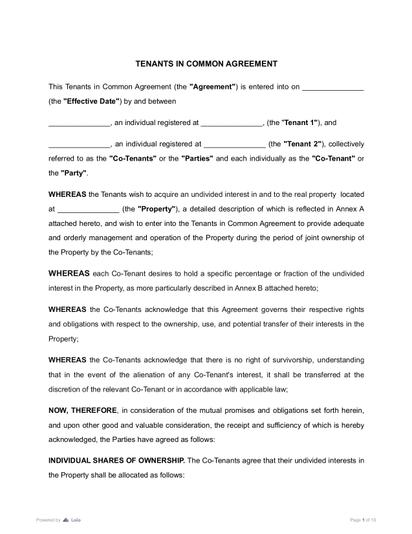
Co-owners need to document their arrangement in writing. For example, a tenancy in common agreement can outline ownership percentages, expense-sharing responsibilities, and procedures for selling an ownership interest.
In a joint tenancy, when one owner dies, their ownership interest automatically passes to the surviving owner or owners. As a result, a last will and testament generally cannot direct that a share be transferred to someone else because the transfer occurs by operation of law.
In a tenancy in common, each owner holds a separate ownership interest that can be transferred, sold, gifted, or inherited. When an owner dies, their share typically passes according to their will or, if no will exists, under state intestacy laws.

When comparing tenants in common vs joint tenants, the primary difference is the right of survivorship.
The right of survivorship is a legal feature of joint tenancy that automatically transfers a deceased owner's share of property to the surviving owner or owners. Because the ownership interest passes directly to the surviving joint tenant, it generally does not become part of the deceased owner's estate and typically avoids probate (the court process of settling a deceased person’s estate).
Once you've selected the ownership structure that best fits your situation, you can create, edit, and customize the necessary documents online and add legally binding electronic signatures to finalize the agreements.
What Is Joint Tenancy?
Joint tenancy is a type of property ownership where two or more people hold equal shares in the same asset. The key feature of this arrangement is the right of survivorship — when one owner dies, their share automatically passes to the remaining owner or owners. For instance, if a married couple buys a house as joint tenants and one spouse passes away, the surviving spouse becomes the sole owner without the need for probate.
Many married couples choose joint tenancy because it simplifies the transfer of property after death. The surviving spouse receives full ownership immediately, and the deceased owner's share does not go through probate court. However, in common-law property states, this structure has a tax drawback: the surviving spouse does not receive a double step-up in cost basis on their own half of the asset.
Some states offer a different option called tenancy by the entirety, which is available only to married couples. Under this form of ownership, both spouses hold equal and complete rights to the property. If one spouse dies, the other automatically becomes the sole owner through the right of survivorship. Another important feature is that neither spouse can sell or transfer their interest without the other spouse's consent.
Key characteristics of joint tenancy:
Equal ownership shares;
Right of survivorship;
Shared rights to use and occupy the property;
Ownership interests are acquired simultaneously;
Commonly used by spouses and close family members.

What Is Tenancy in Common?
Tenancy in common is a more flexible ownership arrangement that allows multiple people to own the same property while holding separate ownership interests.
Unlike joint tenancy, ownership shares do not have to be equal. One owner may hold 70% of the property while another owns 30%. Each owner's interest can be sold, gifted, transferred, or left to beneficiaries through a will.

This structure is frequently used by real estate investors, siblings who inherit property together, or business partners purchasing commercial real estate.
Key characteristics of tenancy in common:
Ownership percentages may be unequal;
No right of survivorship;
Each owner controls their share independently;
Ownership interests can be inherited;
Greater flexibility for estate planning.
Co-Owner Death and Property Rights: Tenancy in Common Versus Joint Tenancy
The outcome depends entirely on the ownership structure, making this one of the most important distinctions in the tenants in common versus joint tenants comparison.
If the property is owned as joint tenants
The deceased owner's interest automatically transfers to the surviving owner or owners through the right of survivorship.
In most cases:
- The deceased owner's share does not pass through probate;
- The ownership interest does not become part of the deceased owner's estate;
- Surviving owners receive full ownership rights automatically.
If the property is owned as tenants in common
The deceased owner's share becomes part of their estate. Depending on the circumstances, the ownership interest may:
- Pass to beneficiaries named in a will;
- Transfer according to state intestacy laws if no will exists;
- Require probate administration before ownership is transferred.
For example, if two siblings own property as tenants in common and one sibling dies, their share could pass to their children rather than the surviving sibling.
Can a Joint Tenancy Be Converted to a Tenancy in Common?
A joint tenancy can be converted into a tenancy in common through a process known as severance.
Severance is the legal process of ending a joint tenancy and converting it into a tenancy in common. When severance occurs, the right of survivorship is removed, and each owner has a separate share of the property that can be sold, transferred, or passed to heirs through a will.
This typically occurs when one joint tenant transfers or sells their ownership interest to another person. Once the required legal steps are completed, the right of survivorship is generally terminated, and the owners become tenants in common.
Other circumstances that may sever a joint tenancy include:
- 1
A sale of an owner's interest;
- 2
Certain court orders;
- 3
Mutual agreements among the owners;
- 4
Property settlements resulting from divorce.
The rules for severing a joint tenancy vary by state. In California, a joint tenant may sever the ownership by recording a written declaration or transferring their interest. Under Cal. Civ. Code § 683.2(c), the document must be notarized before the death of the severing joint tenant and recorded in the county where the property is located. There is one exception: the ownership can be severed after the death of the severing tenant if the document was notarized not earlier than three days before death and recorded in the county where the property is located within seven days after death.
In New York, a joint tenant may also sever the ownership by transferring their share. This converts the joint tenancy into a tenancy in common. Because procedures differ by state, property owners should review their state's laws or consult a real estate attorney before they make changes to the title.
Which Ownership Structure Is Right for You: Tenancy in Common vs Joint Tenancy?
The right ownership structure depends on your personal goals, your relationship with the other owner, and what you want to happen to the property in the future. Whether you choose joint tenancy or tenancy in common, there is no one-size-fits-all option.
Joint tenancy may be a good choice if you are buying property with a spouse or partner and want ownership to transfer automatically to the surviving owner. It can also help simplify the transfer process after death because the property generally avoids probate.
Tenancy in common may be a better fit if owners contribute different amounts, want unequal ownership shares, or plan to leave their interest to children or other beneficiaries. Before deciding, think about what should happen if an owner dies, sells their share, or faces financial challenges.
More guides
September 16
9 min read
Lease vs. Rent: What’s the Difference and What to Choose

September 11
10 min read
Rules for Renting a Room in Your House: How to Become a Landlord
September 4
How To Break a Lease in Florida Without Penalties
September 3
12 min read
The Biggest Red Flags on a Rental Application Explained

September 1
7 min read
How to Provide Proof of Employment: Documents and Steps

July 24
4 min read
What Is a Fixed-Term Lease, and How Is It Different From an Automatic Renewal Lease?

One home for your
agreements
Edit PDFs seamlessly
Tweak agreements before signing or sending for signatures. Update details, add or remove clauses, adjust formatting, and redline changes instantly.
eSign legally and securely
Sign documents and collect legally binding signatures. Invite up to ten people to sign in any order, track the progress, and send reminders.
Request legally binding signatures
Invite up to ten people to sign your document in any order. Get a finalized, audit-ready copy without chasing signatures.
Skip the drafting.
Choose from 2,500+ templates
Browse templatesChoose a template
Fill in details

Sign and download