Updated September 8, 2026
6 min read
Lien Waiver vs. Lien Release: Which One Do You Need?
Are you ready to wait three months to a year to get paid for work you've already finished? That's how long an average lien-related dispute takes to resolve in the U.S.
And the whole problem can come down to just one document, or more precisely, the wrong document: lien waiver vs. lien release. They sound alike, look alike, but serve very different purposes. And confusing the two can cost you months of waiting and thousands in legal fees. What are their differences, and how not to be caught in a trap?
What Is a Lien Waiver?
A lien waiver is a document through which a contractor, subcontractor, or supplier gives up the right to file a mechanic's lien against a property. It protects property owners and general contractors from situations in which they have to pay twice to someone who later claims they were never paid and files a lien anyway.
Lien waivers are standard practice in the construction industry, where projects involve multiple parties – general contractors, subcontractors, and suppliers – who can file liens against the property if they don't get paid.
For instance, a business owner might pay the general contractor in full, but that contractor fails to pay a subcontractor. In this case, the subcontractor can still file a mechanic's lien against the owner's property. Lien waivers create a paper trail that confirms each party received payment and prevent "pay-me-twice" situations.
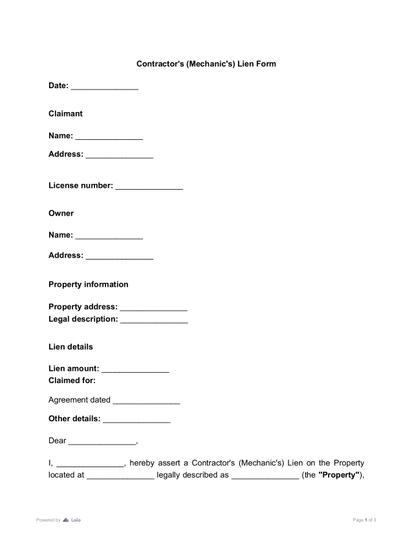
What are the 4 types of lien waivers?
Conditional waiver on progress payment.
This waiver applies to partial payments made during a project. The main word is "conditional"—the waiver only becomes valid after the payment is processed. If the check bounces or the bank transfer fails, the waiver has no effect. The contractor or subcontractor keeps their right to file a lien.
A plumber signs a conditional waiver for a $15,000 progress payment. The waiver means nothing until the $15,000 actually arrives in their bank account.
Unconditional waiver on progress payment.
This waiver also applies to partial payments, but it works differently. The waiver becomes valid the moment you sign it, even if the payment never arrives. There are no conditions and no safety net.
If you sign this waiver before you confirm the money is in your account, you lose your right to file a lien. The payment could fail, and you would have no legal claim to the property.
Conditional waiver on final payment.
This waiver applies to the last payment on a project. Like the conditional progress waiver, it only becomes valid after the money clears. Until the funds hit your account, you still have the right to draft a lien and file it. This version protects the signer until they actually have the money.
Unconditional waiver on final payment.
This waiver ends all lien rights the moment you sign it. The project is done, the signer confirms they received full payment, and they give up any future claim to the property. Once signed, there is no way to file a lien, even if a payment dispute arises later.

When is a lien waiver used?
Lien waivers are common in industries that involve work with contractors, such as construction. It is commonly needed for:
- 1
Progress payments: Each time a contractor receives a payment during a project, the property owner asks for a lien waiver. It confirms the contractor got the money and won't file a lien for that amount later.
- 2
Final payments: Before the owner sends the last payment, they collect waivers from everyone who worked on the project: the general contractor, all subcontractors, and all suppliers.
- 3
Loan disbursements: Banks, investors, and lenders won't release funds without lien waivers. They want proof that previous payments reached the right people. It protects the property (which serves as loan collateral) from unexpected liens.
- 4
Property sales: When a property is sold, the buyer or title company may request lien waivers from any contractors who recently worked on the property to ensure no one has an unpaid claim against it.
- 5
Changes in orders: If the project scope changes and the owner pays extra for additional work, new waivers are needed. The original documents only cover the initially agreed payment amounts.
- 6
Supplier deliveries: Material suppliers sign waivers upon receiving payment for products delivered to the job site.
What Is a Lien Release?
A lien release definition is simple: it is a document that removes a recorded lien from a property title. Unlike a waiver, it addresses a lien that has already been filed and exists in public records. It means the debt or obligation that caused the lien has been satisfied, and the creditor officially removes their claim from the property to let the owner sell, refinance, or transfer this property without problems.
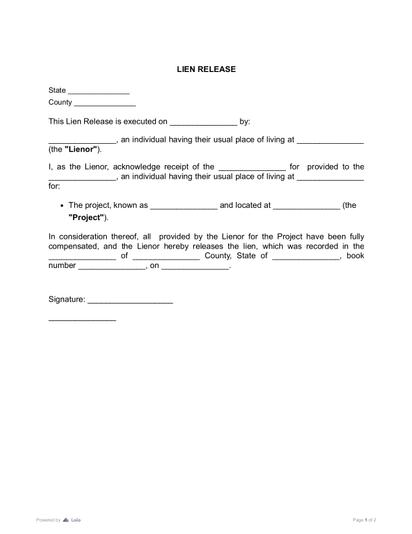
When is a lien release required?
A lien release is needed when a lien exists in public records and must be removed. In particular, it may be required for:
Mortgage payoff: When you finish paying your home loan, the lender should file a lien release with the county recorder. This document may also be called a satisfaction of mortgage or deed of reconveyance, depending on your state.
Mechanic's lien settlement: A contractor filed a lien because they didn't receive payment. Once you pay the amount owed, they must provide a release so the lien can be removed from your property title.
Tax lien resolution: If you owe federal or state taxes, the government may place a lien on your property. After you pay the full amount, the tax authority will issue a release. For federal tax liens, the IRS must file this release within 30 days of full payment.
Judgment satisfaction: A court ordered you to pay a creditor, and the creditor filed a lien against your property. Once you pay the judgment, the creditor files a release of lien, meaning they want to remove their claim.
Property sale: If you want to sell your property that was under a lien, the title company will ask you to provide lien releases before they complete the sale.
Refinance: No lender will approve your loan until all existing liens are cleared from the title.
- Satisfaction of Mortgage
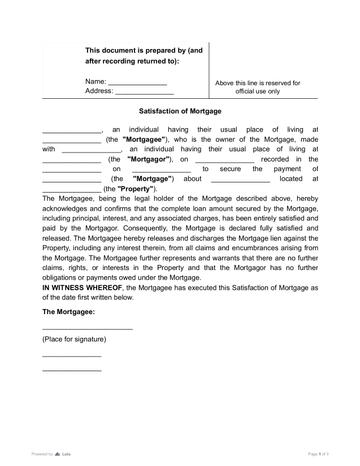 4362 downloads
 - Deed of Reconveyance
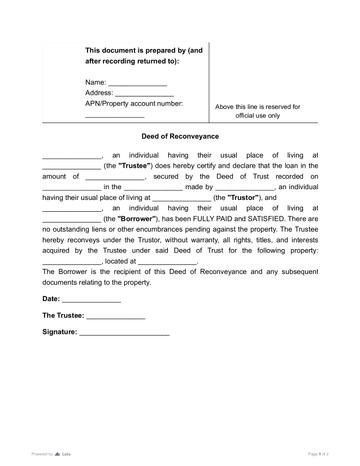 5340 downloads
How is a lien release filed?
The process varies by lien type and state, but the general procedure is as follows:
- 1
Confirm full payment: Before a lienholder will issue a release, the underlying debt must be paid in full. Gather proof of payment: canceled checks, wire transfer confirmations, or receipts.
- 2
Request the release: Contact the party that filed the lien: the contractor or supplier for a mechanic's lien, the lender for a mortgage, and the IRS or state tax agency for a tax lien.
- 3
Get the signed document: A typical lien release includes such information:
- Property description (legal description and/or address);
- Original lien recording information (book, page, document number);
- Statement that the lien is released;
- Date and signature of the lienholder;
- Notarization (if required).
- 4
File the document: Submit the release to the same office where the original lien was recorded – usually the county recorder or register of deeds. Many counties accept e-recording but require the scanned release to have selectable text, not just be a flat image; make the scanned PDF searchable before submitting, or the county may reject the filing. Filing fees may range from $10 to $50 in most jurisdictions.
- 5
Verify the release: After a few days to a few weeks (depending on the county), confirm that the release appears in public records. Order a new title report or search the recorder's online database.
Some states impose deadlines for lien releases. In California, for example, a mechanic's lien claimant must file a release within 15 days of receiving full payment, or they face penalties.
Lien Release vs. Waiver: What Are the Differences?
Though their titles seem very similar, these documents are completely different. Let’s consider the key discrepancies between them:
1. Filing time
- Signed before any lien is filed.
- Typically exchanged when the payment is made or shortly after.
- No government filing is required. It's a private document between parties.
- Filed after a lien already exists in public records.
- The release must be recorded with the county to officially clear the title.
How does a mechanic's lien affect this? If a contractor waives lien rights upfront (via a lien waiver), no mechanic's lien can be filed for that payment. If a mechanic's lien has already been recorded, only a lien release can remove it.
2. Purpose
- Prevents future claims.
- Protects property owners and general contractors from lien filings after payment has been made.
- Resolves existing claims.
- Clears the property title so the owner can sell, refinance, or transfer ownership.
3. Signers
Signed by the party that could file a lien – the contractor, subcontractor, or supplier – and gives up their right to make a claim.
Signed by the party that filed the lien (the lienholder), it removes their recorded claim from the property.
In both cases, property owners are typically the party that requests the document, not the party that signs it.
4. Binding power
The legal strength of a lien waiver depends on its type.
- Conditional waivers only become valid after the payment clears. If the check bounces or the transfer fails, the waiver has no legal effect. The signer keeps their full lien rights.
- Unconditional waivers take effect the moment they are signed. Even if the payment never arrives, the waiver remains valid, and the signer cannot file a lien.
Meanwhile, a lien release becomes fully binding once it is recorded with the county. At that point, the lien disappears from public records, and the lienholder's claim no longer exists. There is no way to undo a recorded release unless fraud or forgery occurred.
5. Frequency
- Multiple waivers are typical on a single project.
- Each progress payment may require a separate waiver from each party in the payment chain.
- A large commercial project might involve dozens or even hundreds of waivers.
- Usually one release per lien.
- Once a lien is released, no additional documents are needed unless a new lien is filed.
7. Risks implied
The lack of each of these documents carries specific risks for property owners.
Without a lien waiver, you may face:
- Double payment. If you pay the general contractor in full, a subcontractor can still claim they never received their share and file a mechanic's lien. In such a situation, you will have to pay again or face foreclosure because you have no proof that anyone waived their lien rights.
- Surprise liens. Months after a project ends, liens may appear on your property from suppliers or laborers you never knew existed. Without waivers, you have no documentation that payments reached everyone in the chain.
- Blocked sale or refinance. If a title company finds outstanding lien rights on your property, you won't be able to sell it and close the deal.
Without a lien release, you may experience the following problems:
- Lien stays on your title. Even after you have paid the debt, the lien can remain in public records. Legally, the creditor still has a claim on your property — even though you owe nothing.
- No rights to sell property: No title company will issue insurance with an unresolved lien.
- Blocked refinancing opportunities: Lenders usually reject applications when they see a lien on the property. In this case, you should either use cash or accept worse interest rates.
- Foreclosure risk. Some liens — especially tax liens — can lead to the forced sale of your property if they remain unresolved for too long.

When Should a General Contractor Request a Lien Waiver vs. Lien Release?
General contractors occupy a unique position. On the one hand, they pay subcontractors and suppliers. On the other hand, they receive payment from property owners, which means lien rights flow in both directions.
A GC should request a lien waiver when they:
- Make a progress payment to a subcontractor or supplier.
- Submit a payment application to the owner (who will want a waiver in exchange).
- Receive a payment request from a subcontractor.
- Close out a project and need final waivers from all parties.
A GC should request a lien release when:
- A subcontractor or supplier has already filed a mechanic's lien against the project.
- They discover a lien during a title search.
- An owner or lender demands proof that a recorded lien has been removed.
How Is a Lien Waiver vs. Release Used in Construction Payment Workflows?
Lien releases vs. waivers serve different roles in construction projects. Lien waivers are exchanged throughout the project. At every payment milestone, contractors, subcontractors, and suppliers electronically sign waivers to confirm they received funds and won't file a lien for that amount.

Meanwhile, lien releases are only used when something goes wrong – a party files a mechanic's lien, the dispute gets resolved – and the lienholder needs to solve it and remove the claim.
Never pay to settle a mechanic's lien without receiving the signed release at the same time. Otherwise, you pay the debt, but the lien remains on your property.
The understanding of the lien waiver vs. release difference is essential for everyone working in construction, real estate, and debt resolution. Though similar in titles, these documents serve different purposes. A lien waiver prevents a future mechanic's lien, while a lien release meaning implies it removes a recorded lien from the property title. The use of the right document will help you protect your property and money. Get them confused, and you may face legal disputes, clouded titles, or double payments.
More guides
September 1
7 min read
How to Provide Proof of Employment: Documents and Steps

August 26
8 min read
When to Hire a Bookkeeper as Your Business Grows
August 5
7 min read
How to Accept ACH Payments from Clients
July 24
4 min read
What Is a Fixed-Term Lease, and How Is It Different From an Automatic Renewal Lease?
July 20
4 min read
Addendum vs. Amendment: Change Your Purchase Agreement Properly
July 22
4 min read
Income Statement vs Profit and Loss Statement: Is There a Difference?

One home for your
agreements
Edit PDFs seamlessly
Tweak agreements before signing or sending for signatures. Update details, add or remove clauses, adjust formatting, and redline changes instantly.
eSign legally and securely
Sign documents and collect legally binding signatures. Invite up to ten people to sign in any order, track the progress, and send reminders.
Request legally binding signatures
Invite up to ten people to sign your document in any order. Get a finalized, audit-ready copy without chasing signatures.
Skip the drafting.
Choose from 2,500+ templates
Browse templatesChoose a template
Fill in details
Sign and download