Updated August 14, 2026
11 min read
Right to Work vs. At Will Employment Explained: What's the Difference?

Right to Work vs. At Will Employment Explained: What's the Difference?
Content
You have probably seen “right to work” and “at-will employment” in a job offer, company policy, or online article — and somehow ended up more confused than before. The phrases sound reassuring, but they often appear without a clear explanation of what they actually mean for your job.
Can your employer dismiss you without warning? Do you have the right to leave at any time? Can union rules affect your employment? These are practical questions, especially when your income and job security are involved, yet many explanations make the topic sound far more complicated than it needs to be.
This guide cuts through the legal language and explains the difference between right to work vs. at will employment in a clear, straightforward way. By the end, you will know which rule applies to which situation and what each one may mean for you as an employee or employer.
Employment at Will vs. Right to Work: Key Differences
The easiest way to understand the difference is to look at the main question each rule answers.
At-will employment answers this question:
Can an employer or employee end the employment relationship without a long legal process?
In most U.S. states, employment is presumed to be at will, meaning an employer may usually terminate an employee at any time, for almost any lawful reason, or for no stated reason at all. An employee may also quit at any time, unless a contract provides otherwise.
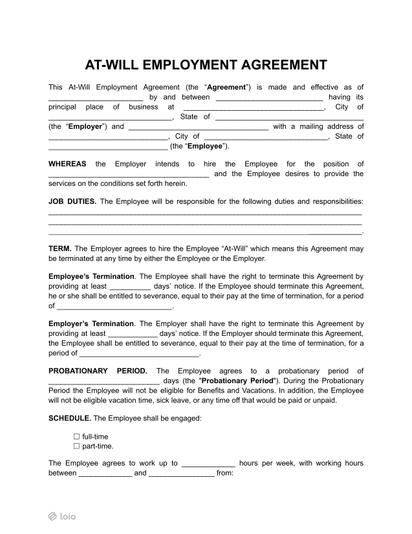
An at-will employment agreement puts this arrangement in writing. It confirms that the job is not guaranteed for a fixed period and that either party can end the employment relationship. Employers may also include additional clauses in the agreement, such as job duties, payment terms, confidentiality obligations, termination rules, severance terms, or other employment conditions.
Right-to-work laws answer this question:
Can an employee be required to join a union or pay certain union fees to keep a job?
In right-to-work states, the answer is no. A worker cannot be forced to join a union or pay union dues as a condition of employment.
Here is the basic difference:

These two concepts can exist at the same time. For example, an employee may work in a right-to-work state and still be an at-will employee.
What Is Employment at Will?
Employment at will means that an employer or employee can end the employment relationship at any time, with or without notice, and with or without a specific reason.
For example, an employee may quit because they found a better job. In many cases, they do not need to prove a legal reason for leaving. In the same way, an employer may terminate an employee because the company is reducing staff, the employee is not meeting expectations, or the business no longer needs that position.
However, at-will employment does not mean an employer can fire someone for any reason in the world. The reason cannot be illegal.
An employer generally cannot terminate an employee because of race, color, religion, sex, or national origin under Title VII of the Civil Rights Act of 1964. Federal law also prohibits covered employers from discriminating based on disability under the Americans with Disabilities Act, age for workers who are 40 or older under the Age Discrimination in Employment Act, and genetic information under the Genetic Information Nondiscrimination Act.
So, at-will employment gives employers flexibility, but it does not remove employee protections.
Standard employment vs. At-will employment
At-will employment is different from employment with just-cause protection. Under a just-cause standard, an employer usually needs a clear, documented, and work-related reason to terminate an employee. The employer may also need to follow specific disciplinary steps before making a final termination decision.
This type of protection is often included in union contracts, executive employment agreements, government employment rules, and other written employment contracts. For example, many federal government employees have legal protections against being fired for arbitrary reasons. Under 5 U.S.C. Chapter 75, certain federal employees generally cannot be removed, suspended, or demoted unless there is “such cause as will promote the efficiency of the service.” This means the agency must usually show a valid reason, such as proven misconduct or unacceptable performance.
At-will employment is the default rule in most U.S. states, including California, Texas, Florida, New York, Illinois, and Pennsylvania. Even in these states, an individual employment contract or collective bargaining agreement can provide additional job security by requiring good cause, advance notice, or specific disciplinary procedures before termination. Employers and employees should therefore review the agreement carefully rather than assume that the default at-will rule always applies.
Can an employment contract override at-will employment?
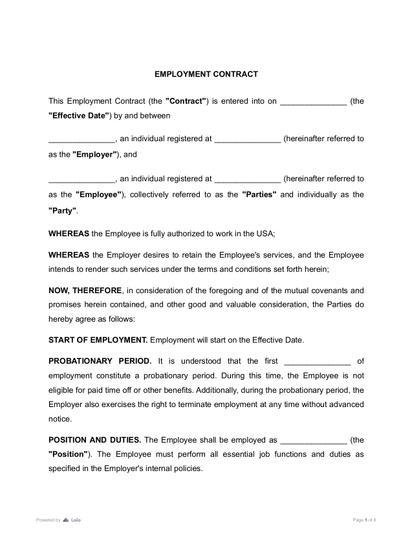
Yes, an employment contract can change the default at-will rule.
At-will employment is usually a default rule. That means it applies unless another valid rule, contract, or agreement says something different.
For example, an employment contract may state that the employee can only be terminated for cause. “For cause” usually means there must be a specific reason for termination, such as serious misconduct, poor performance, violation of company policy, fraud, or another reason listed in the agreement.
A contract may also guarantee employment for a certain period, such as one year. In that case, the employer may not be able to end the relationship early unless the contract allows it.
Collective bargaining agreements can also override at-will employment rules. In unionized workplaces, a collective bargaining agreement may require the employer to follow certain disciplinary steps before firing an employee.
When can an employer legally terminate an at-will employee?
An employer can usually legally terminate an at-will employee when the reason is lawful. Common lawful reasons may include:
Poor performance;
Misconduct;
Attendance problems;
Violation of workplace policies;
Business restructuring;
Position elimination;
Lack of work;
Budget cuts;
Personality or communication issues that affect work;
No specific reason, as long as the real reason is not illegal.
However, an employer generally cannot terminate an employee for illegal reasons, such as:
- Discrimination based on a protected characteristic;
- Retaliation for reporting harassment, discrimination, wage violations, or unsafe conditions;
- Refusing to do something illegal;
- Taking protected medical, family, military, or jury-duty leave where the law applies;
- Filing a workers’ compensation claim;
- Participating in a protected union or workplace organizing activity;
- Reporting illegal conduct as a whistleblower.
A simple way to think about it is this: an at-will employee can be fired for many reasons, but not for an unlawful reason.
Right to Work Explanation
Right to work does not mean every person has a legal right to be given a job. It also does not mean an employee cannot be fired.
Instead, right-to-work laws deal with unions.
In a unionized workplace, a union may represent a group of employees in negotiations with the employer. The union may negotiate wages, benefits, hours, safety rules, grievance procedures, and other working conditions.
In states without right-to-work laws — including California, New York, Pennsylvania, Illinois, Ohio, Michigan, New Jersey, Washington, Massachusetts, and Maryland — a private-sector collective bargaining agreement may require employees in the bargaining unit to pay union dues or equivalent fees as a condition of employment. Right-to-work laws prohibit these compulsory-payment provisions.
In a right-to-work state, an employee cannot be required to join a union or pay union dues as a condition of employment. The employee may choose to join the union, but the employer and union cannot make union membership or financial support mandatory for keeping the job.
The main federal law behind this area is the National Labor Relations Act. Section 7 of the NLRA protects employees’ rights to form, join, or assist labor organizations. It also protects the right to refrain from certain union activities. Section 14(b) of the NLRA allows states and territories to prohibit agreements that require union membership as a condition of employment.
So, right-to-work laws are state-level rules built into the broader federal labor law system.
How right-to-work laws affect union membership
Right-to-work laws mainly affect whether workers must financially support a union.
In a right-to-work state, an employee in a unionized workplace can usually choose not to become a union member. They also generally cannot be forced to pay union dues or agency fees just to keep their job.
Right-to-work laws do not eliminate unions or prevent employees from organizing. Workers remain free to join a union, participate in organizing activities, and negotiate workplace terms through collective bargaining. The main difference is that employees cannot be required to join or financially support the union simply to keep their jobs.
For employees, this means more individual choice about whether to support a union. For unions, it can mean fewer guaranteed funds from the workers they represent. That is why right-to-work laws are often debated. Supporters see them as protecting worker freedom. Critics argue they weaken unions because workers may receive the benefits of union representation without paying for the cost of that representation.
Which States Have Right-to-Work Laws?
As of the latest available data, the following states have right-to-work laws:
Michigan used to be a right-to-work state, but its repeal took effect in 2024. Because state laws can change, employers and employees should always check the current law in their state before relying on a general list.
Common Myths About Right-to-Work and At-Will Employment
Myth 1: Right to work means you have a legal right to a job
This is one of the most common misunderstandings.
Right-to-work laws do not require an employer to hire someone. They do not guarantee employment. They do not protect an employee from being laid off or fired.
Right to work only means that an employee cannot be forced to join or financially support a union as a condition of employment in a right-to-work state.
Myth 2: At-will employment means an employer can fire anyone for absolutely any reason
At-will employment gives employers broad flexibility, but it does not allow illegal termination.
An employer cannot legally fire someone because of protected characteristics, retaliation, whistleblowing, refusing to break the law, or other protected conduct. State laws may also create additional protections.
So, the better rule is: an employer may usually fire an at-will employee for any lawful reason, or no stated reason, but not for an illegal reason.
Myth 3: Right-to-work laws ban unions
Right-to-work laws do not ban unions.
Unions can still operate in right-to-work states. Workers can still organize, join unions, and bargain collectively. The main difference is that employees cannot be required to join or financially support the union as a condition of keeping their job.
Myth 4: At-will employment means employees must give two weeks’ notice
In most at-will jobs, employees are not legally required to give two weeks’ notice unless a contract, policy, or specific law says otherwise.
Two weeks’ notice is usually a professional courtesy, not a universal legal requirement. However, employees should check their employment contract, handbook, bonus agreement, or state-specific rules before leaving.
Myth 5: A signed offer letter always removes at-will employment
Not always.
Many offer letters clearly say that the job is at-will. In that case, the offer letter confirms the job terms but does not create guaranteed employment.
However, if an agreement promises employment for a specific period or says the employee can only be terminated for cause, it may limit at-will employment. The exact wording matters.
Myth 6: Right-to-work and at-will employment are the same thing
They are not the same.
At-will employment is about whether a job can be ended by the employer or employee. Right-to-work laws are about whether union membership or union payments can be required.
A person can be an at-will employee in a right-to-work state. A person can also be an at-will employee in a state that does not have right-to-work laws.
Final Takeaway
Right-to-work and at-will employment are often confused because both phrases sound like they describe general job rights. In reality, they cover different legal issues.
At-will employment means an employer or employee can usually end the employment relationship at any time, unless the reason is illegal or a contract says otherwise.
Right-to-work laws mean employees in certain states cannot be forced to join or financially support a union as a condition of employment.
The simplest way to remember the difference is this: at-will employment is about firing and quitting; right to work is about union membership and union fees.
More guides
September 1
7 min read
How to Provide Proof of Employment: Documents and Steps

September 10
14 min read
How to Protect Your Small Business from Lawsuits

September 15
What Is Contract Redlining?

August 27
4 min read
Forms W4 vs W2 vs 1099: What’s The Difference?

October 7
How to Start a Staffing Agency: Licensing, Pricing, and Cash Flow

July 20
4 min read
Addendum vs. Amendment: Change Your Purchase Agreement Properly

One home for your
agreements
Edit PDFs seamlessly
Tweak agreements before signing or sending for signatures. Update details, add or remove clauses, adjust formatting, and redline changes instantly.
eSign legally and securely
Sign documents and collect legally binding signatures. Invite up to ten people to sign in any order, track the progress, and send reminders.
Request legally binding signatures
Invite up to ten people to sign your document in any order. Get a finalized, audit-ready copy without chasing signatures.
Skip the drafting.
Choose from 2,500+ templates
Browse templatesChoose a template
Fill in details
Sign and download