Updated July 25, 2026
10 min read
Starting a Plumbing Business in 2026: What You Need to Know

Starting a Plumbing Business in 2026: What You Need to Know
Content
Plumbing services are always in demand. Homeowners and businesses need pipes fixed, drains cleared, and water heaters installed all the time, regardless of economic conditions. If you have plumbing skills and want to be your own boss, 2026 is an excellent time to start your project. This guide gives detailed instructions on how to open a plumbing company, from market research and licensing to pricing and client acquisition.
What Services Does a Plumbing Business Offer?
Don't try to do everything at once. More services on your list require additional investment, but there's no guarantee this money will pay off immediately. Start with the basic services for residents that will provide you with a pool of clients and form your reputation as a reliable and skilled professional:
Drain cleaning;
Leak repairs in faucets, toilets, pipes, and water lines;
Water heater installation and repairs;
Sinks, toilets, and showers installation;
Garbage disposal replacement;
Pipe repairs;
Sump pump service.
Every time you provide any kind of services, you and the client should electronically sign a written document that lists the services provided. A plumbing contract details the scope of work, the deadlines for the work to be done, and the pricing for a plumbing project.

Once your business starts bringing steady revenue, you can expand into:
Commercial plumbing contracts;
New construction rough-ins;
Gas line installation (you'll need a separate certification for this);
Sewer line replacement and trenchless repair;
Water treatment system installation.

How to Start a Plumbing Company?
Starting your own plumbing business is not complicated if you follow the right procedure and prepare all the documentation on time. Here are the key steps you should follow to open a company in your state:
1. Research the local market and demand
Before you invest money in a business, study your local market. Answer these questions:
How many plumbing companies operate in your area? Search Google Maps and Yelp. Count competitors within a 20-mile radius.
What do they charge? Call five competitors and ask their prices for the most popular services (drain cleaning, water heater install, leak repair). Make notes.
What do customers complain about? Read one-star reviews of local plumbers. Common complaints show the key pain points – slow response times, poor communication, hidden fees – you need to avoid.
Are there underserved neighborhoods? New housing blocks also generate demand but may lack the professionals to provide services. A 30-minute drive can bring you dozens of new clients.
What's the population trend? If the area is growing, it will need more plumbers. Meanwhile, shrinking areas mean fierce competition.
2. Prepare a business plan
Before you learn how to open a plumbing company, you need a clear plan outlining how it will operate, how much money you need to start, what revenue you expect, and how you're going to move towards your business goals. You may also need this document when applying for loans or communicating with investors.
A well-structured business plan for a plumbing company should include the following sections:
- 1
Executive summary: One-page overview of your business concept, target market, competitive advantage, and financial goals.
- 2
Company description: Legal structure, ownership, location, and mission statement.
- 3
Market analysis: Summarize your research. Include competitor analysis, target customer profiles, and demand triggers in the plumbing industry.
- 4
Services offered: List every service you'll provide at launch and planned additions for years two and three.
- 5
Marketing strategy: How will you attract customers? Detail your plans for online presence, local advertising, referral programs, and partnerships.
- 6
Operations plan: Describe your company's daily operations: how you will process your clients' requests, schedule your work, manage inventory, and control the quality of the services provided.
- 7
Financial projections: Describe how you see your company's financial success within three years. Include:
- Startup costs (licenses, tools, vehicle, insurance, marketing);
- Monthly fixed costs (insurance, software, vehicle payment, phone);
- Variable costs (materials, fuel, subcontractors);
- Monthly expected revenue;
- Break-even analysis.
- 8
8. Funding: If you seek outside investments, specify how much money you need and how you'll use it.
Your business plan will change over time as your business develops, but to start, you need to understand what you're aiming at and how you can reach it.
3. Find the financing
To start a plumbing business, one needs between $10,000 and $90,000. The sum varies depending on the location where you operate, the number of hired employees, and the equipment needed. If you have an opportunity to use this money from personal savings, it offers many advantages: no debt, no interest, and no need to wait for approval. However, here’s how to start your own plumbing business if you do not have startup capital:
SBA loans: The Small Business Administration backs loans through regular banks. The 7(a) program offers up to $5 million with 10% down. Microloans max out at $50,000. To get SBA financing for your plumbing business, you'll need a solid business plan, credit above 680, and probably some collateral. The approval takes 45-90 days.
Equipment financing: Lenders can finance your van, tools, and machines using the equipment itself as collateral. Typical terms are 3-7 years at 6-15% interest.
Credit cards: This option is fine for smaller purchases and short-term gaps. Look for 0% intro APR offers and pay them off before the rate jumps.
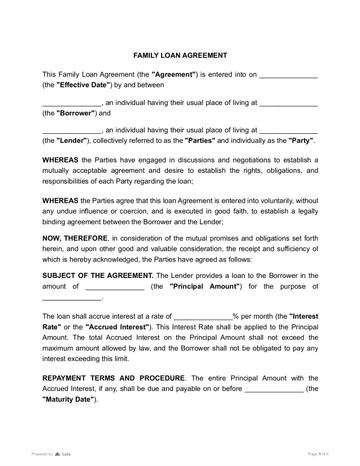
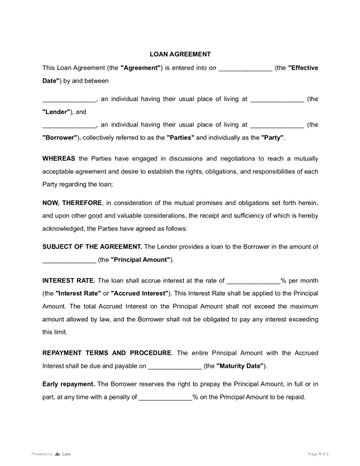
Family loans: Sign an official family loan agreement to document the deal and specify all the details: amount, interest, payment schedule, and consequences for missed payments. To ensure you have drafted the agreement correctly, check it with a contract reviewer.
- Family Loan Agreement
 5557 downloads
 - Loan Agreement
 4485 downloads
4. Choose the business structure
This choice will affect your taxes, personal liability, and how much paperwork you will deal with.
Sole proprietorship: Is the easiest to set up and requires no state filings. However, it offers no liability protection, so if someone sues your business, they can take your house, your truck, and your personal savings.
LLC (Limited Liability Company): Is the most popular option among small businesses, as it creates a wall between the company and your personal assets. If a customer sues over water damage, they can go after the business, but your personal belongings stay protected. Therefore, you need to register an LLC before you take on clients. State filing fees will cost you $50-$500.
S-Corporation: This option requires more paperwork but can save you money on self-employment taxes once you're making $70K+ in profit. You pay yourself a salary and take the rest as distributions. You can switch to an S-corporation from an LLC once you start making more money.
5. Register your company
Once you decide what business structure to choose, you must register your plumbing company. For this, follow these steps:
- 1
Register with your state:
File formation documents with your state's Secretary of State office. For an LLC, submit Articles of Organization. Most states process filings within 5 to 10 business days. Expedited service costs extra.
- 2
Obtain an EIN:
An Employer Identification Number (EIN) is a nine-digit number the IRS assigns to businesses. A plumbing company needs an EIN for taxes, banking, and payroll. You cannot open a business bank account, hire employees, or file business tax returns without one. You can apply for free at the IRS website.
- 3
Register for state and local taxes:
Most states require registration with the Department of Revenue for sales tax collection (if your state taxes services) and income tax withholding (if you have employees).
- 4
Register your business name:
If you operate under a name different from your legal LLC name, file a DBA ("Doing Business As") with your state or county. Fees typically run $10 to $100.
6. Get essential licenses and permits
A plumbing business requires a plumbing license in all 50 states. However, the requirements vary significantly by state. You may need:
Journeyman or Master Plumber license. Requires 2-5 years of apprenticeship plus a written exam. Some states add a practical test.
Contractor license. Some states won't let you operate a plumbing business with just your personal plumber’s license. You need a separate contractor credential.
Business license. Your city or county issues this. It's basically permission to operate commercially.
Check your state's contractor licensing board for exact requirements. Don't skip this because working without proper licenses can mean fines, lawsuits, and losing the ability to get licensed later.
7. Open a bank account
Always keep your business and personal finances separate. If you mix funds, a court can decide your LLC doesn't really exist as a separate entity. That's called "piercing the corporate veil," and it means your personal assets lose protection.
To open a business bank account for your plumbing business, you need:
EIN confirmation letter (IRS Form CP 575 or SS-4 confirmation);
Articles of Organization or Certificate of Formation;
Government-issued ID;
Business license (if already obtained).
Once all documents are ready, follow this process:
- 1
Compare business checking accounts at 3 to 5 banks. Look for low fees, free transactions, and convenient branch locations.
- 2
Schedule an appointment and visit it with your documents.
- 3
Complete the bank's application forms.
- 4
Make an initial deposit.
- 5
Order checks and a debit card.
- 6
Set up online banking and mobile deposit.
Many banks offer new business promotions: cash bonuses of $200 to $750 for meeting deposit or spending thresholds in the first few months.
8. Prepare the basic tools
Buy professional-grade equipment because cheap tools break at the worst times and cost more in replacement. At the start, you will need:
Hand tools: Pipe wrenches (14", 18", 24"), adjustable wrenches, basin wrench, pliers set, screwdriver set, hex key set, tape measure, level, hacksaw, tubing cutter, PEX crimping tool.
Power tools: Cordless drill/driver, reciprocating saw, rotary hammer (for concrete), inspection camera.
Drain cleaning: Hand auger (25'), toilet auger, drain machine (50' to 100'), drain bladder.
Soldering/joining: Propane torch, solder, flux, pipe dope, Teflon tape, PVC primer, and cement.
Safety equipment: Safety glasses, work gloves, knee pads, ear protection, and a respirator mask.
Diagnostic tools: Multimeter, water pressure gauge, thermometer, leak detection dye.
Vehicle organization: Toolboxes, shelving system, parts bins, and a first aid kit.
If you need additional tools, you can buy or lease the equipment later.
9. Set your prices
Correct pricing determines whether your business survives or fails. If the price is too low, you can't cover the costs; if it is too high, you lose bids to competitors.
There are typically two pricing models you can apply:
Hourly rate: Charge for time plus materials. Calculate your hourly rate with this formula:
(Annual salary goal + overhead costs + profit margin) ÷ billable hours = hourly rateAdd material costs plus a markup (typically 15% to 30%) to the labor charge.
- Desired salary: $70,000;
- Annual overhead (insurance, vehicle, tools, marketing): $30,000;
- Profit margin (20%): $20,000;
- Billable hours (1,500 per year): 1,500;
- Hourly rate: ($70,000 + $30,000 + $20,000) ÷ 1,500 = $80/hour.
Flat rate: A fixed price for each job type. Customers prefer this approach because they know the total cost upfront. You benefit when you complete jobs faster than estimated.
Create a price book with flat rates for common services:
- Unclog drain: $150 - $300;
- Faucet replacement: $200 - $400;
- Toilet replacement: $300 - $600;
- Water heater installation: $1,200 - $3,000;
- Leak repair: $150 - $500.
Review and adjust prices annually. Track your actual time and costs for each job type to update your estimates.
10. Get business insurance
One flooded basement or a slip-and-fall in a customer's house may cost you a fortune if you do not have insurance. There are different options you can choose from:
- 1
General liability insurance covers property damage and bodily injury claims. If you accidentally flood a customer's basement, this policy pays for repairs. It typically costs $500 to $2,000 per year and covers up to $1 million per occurrence.
- 2
Commercial auto insurance covers your work vehicle for accidents, theft, and damage. Personal auto policies exclude business use. The typical cost is $1,200 to $3,000 per year.
- 3
Workers' compensation insurance is required in almost every state if you have employees. It covers medical expenses and lost wages for work-related injuries.
- 4
Tools and equipment coverage protects your tools and equipment against theft, damage, and loss.
- 5
Professional liability insurance covers claims of faulty workmanship. Less common for plumbers than general contractors, but it is worth consideration.
11. Build your online presence
When someone's toilet overflows at 10 PM, they grab their phone and search for "plumber near me." If you don't show up, you don't exist.
To help them find you, you need to be present online. Here's how you can do it:
Google Business Profile: Claim your listing, add photos of your work, and list your services. Ask every happy customer for a review. Businesses with complete profiles get 7x more clicks.
Simple website: You need a home page, services page, service area, and contact info. Put your phone number at the top of every page with a click-to-call button. It may cost you $500-$2,000 for a professional website or $200/year if you build it yourself on Squarespace or Wix.
- Clear list of services;
- Service area map;
- Contact form and phone number on every page;
- About page with your credentials and story;
- Customer testimonials;
- Photos of your work;
- Online scheduling (optional but valuable).
Review sites: Set up profiles on Yelp, Angi, and Thumbtack. Respond to every review within a couple of days, good and bad.
Social media: A Facebook page is enough to start. Post job photos, tips, and the occasional promotion. The goal isn't to become an influencer. It's to show up when people search and look legitimate when they find you.

Keep your business name, address, and phone number the same across all listings.
How Can You Find Your First Plumbing Business Clients?
Owning a plumbing business means searching for customers all the time. Your first ten clients won't come from Google ads. They'll come from hustle. Here's how you can make it:
- 1
Tell everyone. Friends, family, neighbors, former coworkers, your kid's soccer coach. Let them all know you started a plumbing business. Hand out cards.
- 2
Hit the pavement. Door hangers in neighborhoods with older homes. These houses have aging pipes, original water heaters, and owners who need plumbers.
- 3
Partner up. HVAC techs, electricians, general contractors, and property managers all run into plumbing problems they don't handle. Offer a referral fee for clients they send you.
- 4
Answer the phone. Seriously. When someone calls with a clogged drain at 7 PM on Saturday, be the plumber who picks up. Availability beats advertising.
- 5
Launch promotion. "20% off your first service" or "Free drain inspection" gets people to try you.
How Much Does It Cost to Start a Plumbing Business?
Startup costs vary based on your existing resources, location, and service scope. Minimum startup budget for a plumbing company is as follows:
- LLC formation: $50 - $500;
- Business licenses and permits: $100 - $500;
- Plumbing contractor license: $100 - $1,000;
- Insurance (first year): $2,000 - $5,000;
- Basic tools: $1,500 - $3,000;
- Vehicle (used van or truck): $10,000 - $25,000;
- Vehicle setup (shelving, signage): $500 - $2,000;
- Website: $500 - $2,000;
- Initial marketing: $500 - $2,000;
- Working capital (3 months): $3,000 - $10,000.
- Total: $18,250 - $51,000
However, many plumbing businesses launched with $15,000 to $25,000 in total capital. The key is to start small, reinvest profits, and expand gradually.
How Much Money Does a Plumbing Company Make?
Once you know how to open a plumbing business, you may wonder how much money it can bring. The income a plumbing company owner may get varies widely based on location, specialization, and the business model they choose.
For instance, a solo plumber who completes 3 to 5 service calls per day at an average ticket of $250 generates $750 to $1,250 in daily revenue. At 250 working days per year, that equals $187,500 to $312,500 in annual revenue. After expenses, they typically net $50,000 to $120,000 in annual profit.
Meanwhile, a plumbing company that has employees may earn:
- 1
2 to 3 plumbers: $300,000 to $750,000 annual revenue;
- 2
5 to 10 plumbers: $750,000 to $2 million annual revenue;
- 3
10+ plumbers: $2 million+ annual revenue.
Net profit margins for plumbing companies typically range from 10% to 25%, depending on efficiency, pricing, and overhead control.
Starting a plumbing business offers strong income potential, steady demand, and a clear path to growth. Start with core residential services, build your reputation through quality work and customer service, and expand as cash flow allows. The industry will need more new plumbers just to keep up with demand and retirements — plenty of room exists for well-run companies to thrive.
More guides
July 25
12 min read
How to Register a Company in the US: What No One Tells You in 2026

September 1
7 min read
How to Provide Proof of Employment: Documents and Steps

October 8
8 min read
How to Start a Videography Business: 8 Essential Steps

October 15
How to Start a Staffing Agency: Licensing, Pricing, and Cash Flow

July 25
12 min read
How to Start a Flooring Business and Get Your First Clients in 2026

October 8
8 min read
A Comprehensive Guide to Starting a Child Care Business

One home for your
agreements
Edit PDFs seamlessly
Tweak agreements before signing or sending for signatures. Update details, add or remove clauses, adjust formatting, and redline changes instantly.
eSign legally and securely
Sign documents and collect legally binding signatures. Invite up to ten people to sign in any order, track the progress, and send reminders.
Request legally binding signatures
Invite up to ten people to sign your document in any order. Get a finalized, audit-ready copy without chasing signatures.
Skip the drafting.
Choose from 2,500+ templates
Browse templatesChoose a template
Fill in details
Sign and download